Introduction
Walking down the organizational aisle of any home goods retailer can quickly induce decision fatigue. Rows of crystal-clear plastic bins, stacked woven seagrass baskets, and heavy wooden storage cabinets all promise to cure your household clutter. Yet, choosing the wrong containment medium for your specific items often leads to wasted money, awkward spatial configurations, and a home that still feels disorganized.
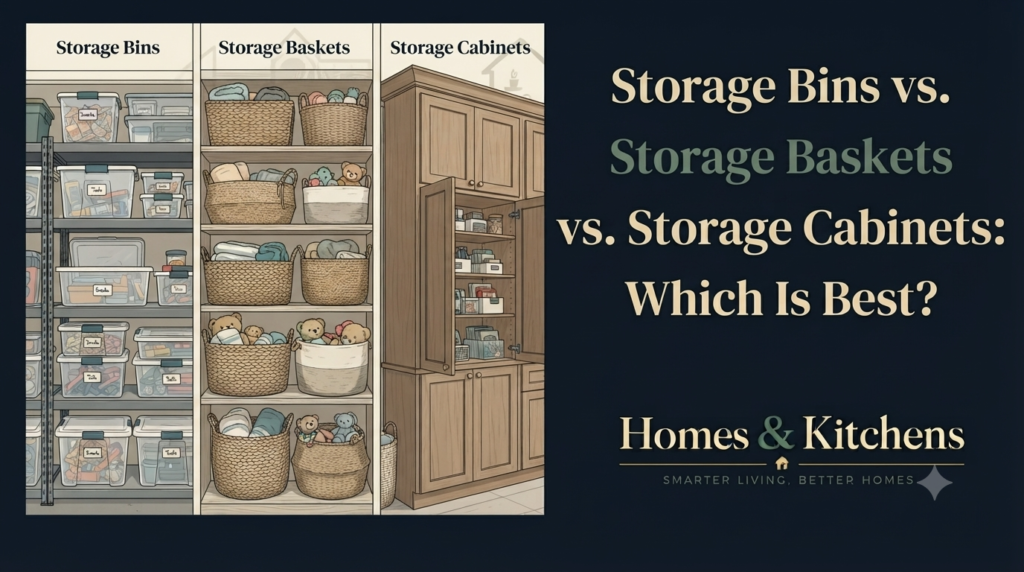
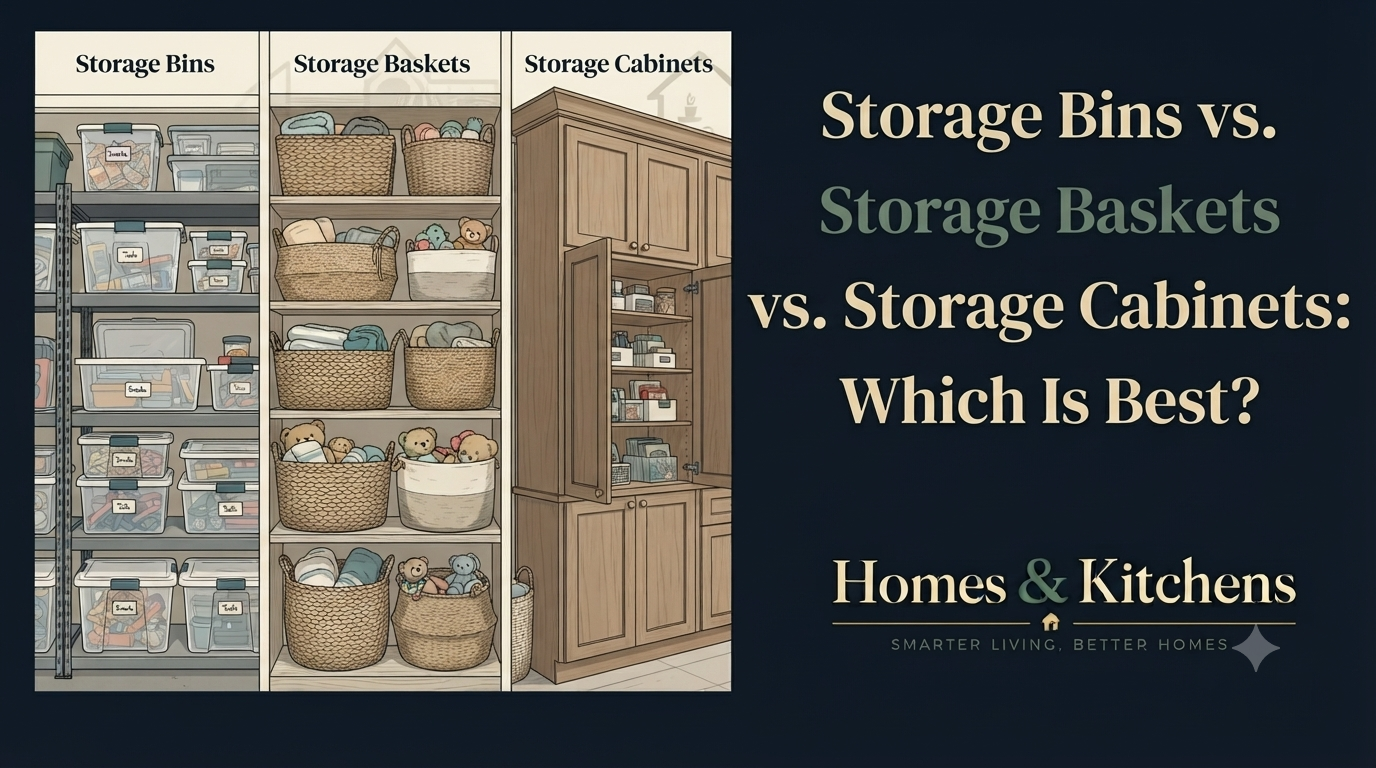
The eternal debate between storage bins, storage baskets, and storage cabinets is not merely a matter of aesthetic preference. Each storage medium serves a distinct structural purpose, offering unique balances of visibility, dust protection, aesthetic warmth, and physical capacity. At Homes & Kitchens, our knowledge-first philosophy emphasizes that understanding the mechanical and functional differences between these three storage titans is the secret to building an enduring, stress-free home. This comprehensive guide breaks down everything you need to know to select the right storage solution for every room in your house.
The Philosophy of Containment: Closed vs. Open Storage
Before examining bins, baskets, and cabinets individually, it is essential to understand the overarching architectural division in home organization: closed storage versus open storage.
The Role of Closed Storage
Closed storage—typified by heavy wooden cabinets and lidded bins—completely hides contents from view.
- The Benefits: It eliminates visual static, protects delicate textiles and electronics from airborne dust and UV degradation, and maintains a clean, minimalist aesthetic.
- The Limitations: Out of sight often translates to out of mind, making it easy to forget what you own and accidentally purchase duplicate items.
The Role of Open Storage
Open storage—represented by woven baskets without lids and clear bins on open shelving—keeps items instantly accessible.
- The Benefits: It speeds up daily retrieval times and forces you to maintain an edited inventory since everything is visible to family members and guests.
- The Limitations: It exposes items to dust, grease (particularly in kitchens), and visual clutter if the contents are mismatched or untidy.
Storage Bins: The Utility Powerhouse
Storage bins are engineered for rigorous utilitarian function. Typically constructed from rigid plastics, heavy-duty canvas, or corrugated polypropylene, bins prioritize durability, moisture resistance, and stackability.
Anatomy and Structural Varieties
- Clear Plastic Bins: Manufactured from shatter-resistant polymers, these allow complete visual identification of contents without requiring labels.
- Canvas and Fabric Bins: Built with rigid cardboard or wire inserts wrapped in durable fabric, these offer a softer aesthetic suited for closets and children’s rooms.
- Lidded Industrial Bins: Designed with secure latches or snap-on lids, these protect contents from moisture, pests, and crushing weight.
Best Applications for Storage Bins
- Garages and Basements: Protecting seasonal camping gear, holiday decorations, and automotive supplies from damp concrete and dust.
- Children’s Playrooms: Coralling small toys, building blocks, and art supplies where rugged drops and rough handling are guaranteed.
- Pantry Floor Shelving: Storing bulky bulk-food bags and canned goods safely away from light and pests.
Product Recommendations
- Best Overall Storage Bin:Rubbermaid Roughneck Plastic Storage Box
- Why We Chose It: Built with impact-resistant resin that withstands extreme temperature shifts without cracking, featuring secure snap-on lids and a stackable footprint.
- Price Range: $
- Best for Small Spaces & Closets:Sorbus Foldable Fabric Storage Bins
- Why We Chose It: Combines a collapsible fabric frame with dual reinforced handles, making them ideal for sliding onto closet shelves or cube organizer units.
- Price Range: $
Storage Baskets: Texture, Warmth, and Accessible Style
Storage baskets bridge the gap between hard utilitarian containers and soft home decor. Woven from natural fibers like seagrass, rattan, water hyacinth, or durable synthetic resin cords, baskets introduce organic texture and warmth into living spaces.
Anatomy and Structural Varieties
- Natural Fiber Baskets: Woven from plant materials, offering gorgeous organic variation and breathability, though vulnerable to high moisture environments.
- Synthetic Resin Baskets: Engineered to mimic natural wicker using washable polyethylene resin over a wire frame, making them ideal for damp bathrooms and kitchens.
- Wire Baskets: Constructed from welded steel wire, providing maximum airflow and rugged industrial strength.
Best Applications for Storage Baskets
- Living Rooms: Housing throw blankets, reading pillows, and board games right beside the sofa where open access is essential.
- Entryways: Holding mail, gloves, and dog leashes in a decorative drop-zone tray or low cubby.
- Bathrooms: Storing rolled hand towels and toilet paper rolls while resisting humidity.
Product Recommendations
- Best Overall Storage Basket:BirdRock Home Water Hyacinth Storage Basket
- Why We Chose It: Hand-woven over a sturdy iron wire frame, offering rich natural texture, built-in carry handles, and a durable structure that holds its shape under heavy loads.
- Price Range: $$
- Best Budget Basket:Goodline & Co. Cotton Rope Basket
- Why We Chose It: Soft, flexible organic cotton construction that will not scratch wooden furniture or snag delicate knitwear, featuring reinforced stitching.
- Price Range: $
Storage Cabinets: Permanent Architecture and Maximum Security
Storage cabinets represent a permanent furniture investment. Whether freestanding, built-in, or wall-mounted, cabinets offer heavy-duty structural capacity and total visual concealment.
Anatomy and Structural Varieties
- Freestanding Pantry and Utility Cabinets: Tall, multi-shelf wooden or steel units designed to anchor against a wall, providing massive vertical storage for kitchen supplies or linens.
- Credenzas and Sideboards: Low-profile architectural cabinets featuring doors and internal shelving, perfect for living and dining rooms.
- Locking Metal Security Cabinets: Industrial-grade steel lockers designed to secure hazardous chemicals, tools, or sensitive documents away from children.
Best Applications for Storage Cabinets
- Kitchens and Pantries: Storing small appliances, fine china, and food supplies behind closed doors to eliminate visual kitchen clutter.
- Home Offices: Housing printers, reams of paper, and confidential client files away from direct light and dust.
- Garages: Safely locking away power tools, garden fertilizers, and automotive fluids.
Product Recommendations
- Best Overall Storage Cabinet:Sauder Select Tall Storage Cabinet
- Why We Chose It: Engineered wood construction finished in durable laminate, featuring adjustable interior shelving and European-style concealed hinges for a clean, architectural facade.
- Price Range: $$$
- Best Premium Cabinet:ClosetMaid Impressions 4-Shelf Hutch Cabinet
- Why We Chose It: Premium thickness construction with decorative moldings and configurable doors, offering high-end custom built-in looks at a modular price point.
- Price Range: $$$$
Comprehensive Comparison Matrix: Bins vs. Baskets vs. Cabinets
To evaluate how these three storage mediums compare across key performance and architectural metrics, review the matrix below:
| Feature / Metric | Storage Bins | Storage Baskets | Storage Cabinets |
| Visual Privacy | Complete (if opaque/lidded) | Low to Moderate (open top) | Absolute (closed doors) |
| Dust & Pest Protection | High (with secure lids) | Minimal (open weave allows dust) | High (sealed frame and doors) |
| Aesthetic Warmth | Low (utilitarian aesthetic) | High (organic textures & warmth) | High (fine furniture finish) |
| Mobility & Weight | Lightweight; highly portable | Moderate; easy to carry by handles | Heavy; stationary furniture |
| Durability in Damp Areas | Excellent (plastic/resin types) | Moderate (natural fibers mold in humidity) | Low to Moderate (wood warps in dampness) |
| Cost Range | $ (Inexpensive) | $$(Moderate) \vert{}$$$$ (Investment level) | |
| Best Room Application | Garage, Basement, Playroom | Living Room, Bedroom, Bath | Kitchen, Office, Dining Room |
Common Storage Selection Mistakes to Avoid
Choosing the wrong storage container for a specific room or task is a frequent pitfall. Keep these expert warnings in mind:
- Using Natural Baskets in Damp Bathrooms: Woven seagrass and wicker absorb moisture from steamy showers, leading to mold growth and fiber degradation. Use resin wicker or plastic bins in high-humidity zones.
- Relying Solely on Open Bins in Dusty Areas: Storing items in open-topped bins in garages or dusty attics exposes your belongings to a thick layer of grime within weeks. Always opt for lidded bins in unconditioned spaces.
- Treating Storage Cabinets as Catch-All Black Holes: Pushing items deep into dark cabinet shelves without sub-dividing them creates disorganized clutter behind closed doors. Use shelf risers and small bins inside cabinets.
- Ignoring Room Proportions: Placing a massive, heavy wooden storage cabinet in a tiny studio apartment overwhelms the floor plan. Opt for vertical floating cabinets or low-profile rolling bins instead.
Frequently Asked Questions
1. What is the main difference between storage bins and storage baskets?
Storage bins are typically utilitarian, rigid, and feature secure lids for maximum dust and moisture protection, whereas storage baskets are open-topped, decorative, and woven from natural or synthetic fibers to add textural warmth.
2. When should I choose storage cabinets over bins or baskets?
Choose storage cabinets when you need to completely hide visual static, lock away hazardous or valuable items, or invest in permanent furniture that matches your home’s architectural style.
3. Are plastic storage bins better than woven baskets?
Neither is universally better; plastic bins excel in utilitarian, moisture-prone spaces like garages and basements, while woven baskets excel in living areas where aesthetic warmth and quick access are priorities.
4. How do I prevent natural fiber baskets from gathering dust?
Vacuum woven baskets periodically using a soft brush attachment, or wipe them down with a slightly damp microfiber cloth to remove trapped dust between the weave.
5. Are modular storage cabinets sturdy enough for heavy dishware?
Yes, provided you verify the weight capacity of the interior shelves and anchor the cabinet securely to wall studs to prevent tipping hazards under heavy loads.
6. Can I use storage bins inside living room furniture?
Yes, square fabric bins fit perfectly inside cube organizer shelving units, allowing you to conceal toys and media gear while maintaining a tidy living room aesthetic.
7. How do I choose between clear and opaque storage bins?
Choose clear bins when you need instant visual identification of contents (such as seasonal clothing or craft supplies), and choose opaque bins when you want to hide mismatched visual clutter.
8. What is the best storage solution for a small apartment entryway?
A low-profile storage bench with internal cabinet doors or sliding baskets provides both seating and shoe containment without blocking narrow walkways.
9. How often should I audit my storage bins and cabinets?
Conduct a thorough organizational audit twice a year during seasonal transitions to purge unused items and reorganize container contents.
10. Are wire baskets safe for storing delicate clothing?
Wire baskets can snag delicate silks and fine knits unless lined with a soft cotton fabric insert or canvas liner.
Key Takeaways
- Match Medium to Environment: Use rigid plastic bins for damp or dusty utility spaces, decorative baskets for living areas, and cabinets for permanent architectural storage.
- Prioritize Dust Protection: Reserve lidded containers for items accessed infrequently, and use open baskets for high-frequency daily items.
- Balance Aesthetics and Utility: Do not sacrifice structural integrity for style; ensure your chosen storage solution can safely support the weight of its contents.
- Anchor Heavy Furniture: Always secure tall storage cabinets directly to wall studs to prevent dangerous tip-over accidents.
Final Recommendation
Choosing between storage bins, storage baskets, and storage cabinets comes down to balancing utility, visibility, and aesthetics. For rugged, moisture-prone utility zones like garages and pantries, invest in durable lidded plastic bins. For living spaces where warmth and accessibility matter most, use textured woven baskets. Finally, for permanent rooms requiring total visual concealment and heavy load capacities, anchor a quality wooden storage cabinet. Assess your room’s specific demands today and build an organized home designed to last.
Call to Action
Ready to optimize your entire home? Explore our comprehensive Kitchen Cabinets Guide, review our expert advice on Kitchen Organization Ideas, or discover how to maximize your living quarters with our in-depth design breakdowns.