Introduction
Picture this: It is a chilly Sunday afternoon in late November. The kitchen window is slightly fogged from the steam rising off the stove, and the unmistakable aroma of slow-simmering beef chuck roast, red wine, and root vegetables fills the entire house. On the counter sits a loaf of sourdough, its crust crackling as it cools, achieving that professional bakery-style rise and blister that usually feels impossible to replicate in a home kitchen.
What is the common denominator behind both of these culinary feats? More often than not, it is a heavy, brilliantly colored enameled cast iron Dutch oven.
For generations, this humble piece of cookware has been the undisputed heavyweight champion of the American kitchen. Whether you are deep-frying chicken, boiling a batch of Sunday marinara, baking no-knead artisan bread, or braising short ribs until they practically melt off the bone, a quality Dutch oven handles it all with effortless grace.
Yet, walking down the cookware aisle—or browsing online storefronts—can feel overwhelming. With prices ranging from under fifty dollars to upwards of five hundred, and choices spanning enameled cast iron, raw cast iron, and multi-ply stainless steel, how do you know which pot deserves a permanent spot on your stovetop?
Drawing on years of culinary testing, kitchen design expertise, and hands-on home cooking experience, this guide cuts through the marketing noise. We will explore what makes a truly great Dutch oven, compare top contenders, and help you choose the exact piece of cookware that fits your cooking style, budget, and kitchen aesthetic.
Understanding the Dutch Oven: Why Every Kitchen Needs One
Before diving into specific product recommendations, let us look at why this specific pot earns so much counter space in U.S. homes.
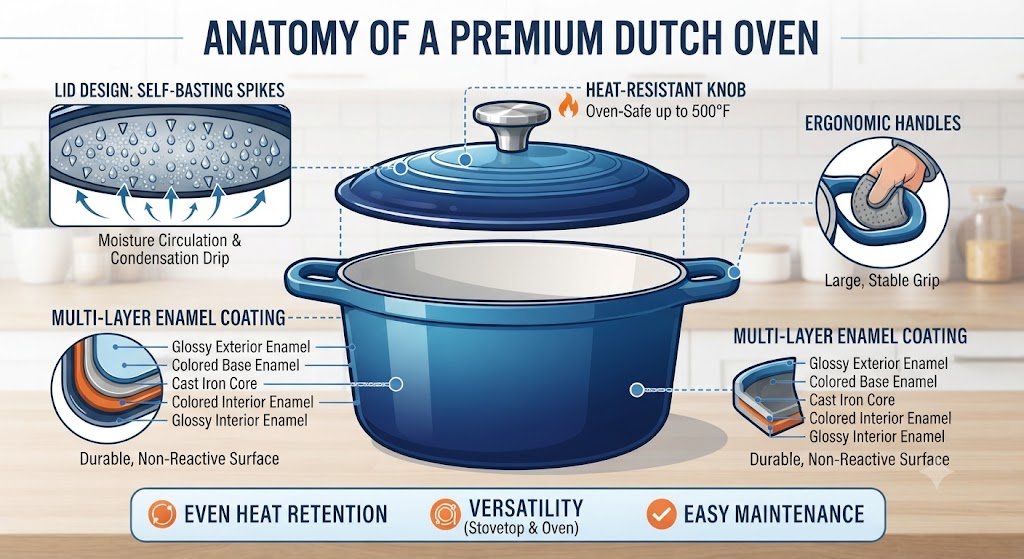
A Dutch oven is essentially a thick-walled cooking pot with a tight-fitting lid. Traditionally crafted from seasoned cast iron, modern standards heavily favor enameled cast iron because it pairs the unbeatable heat retention of iron with a smooth, glass-like vitreous enamel coating that requires zero seasoning and refuses to react with acidic ingredients like tomatoes or wine.
The Physics of Heat Retention
During testing in various home kitchen environments, the standout performance metric of a heavy-gauge Dutch oven is its thermal mass. Unlike thin stainless steel pans that heat up and cool down instantly, a quality Dutch oven absorbs heat slowly and distributes it with absolute uniformity.
When you drop a cold cut of meat into a preheated Dutch oven, the pot does not suffer from temperature shock. Instead, it maintains its heat, allowing you to achieve a deep, mahogany sear without boiling the meat in its own juices.
Versatility Across Heat Sources
One practical lesson homeowners often discover is that a great Dutch oven acts as a culinary chameleon. You can start a meal on a gas, electric, or induction stovetop, transfer the entire pot straight into a 500°F oven to finish braising or baking, and then bring it directly to the dining table as a rustic, elegant serving piece.
- Stovetop: Perfect for searing, sautéing, simmering, deep-frying, and boiling.
- Oven: Ideal for braising, slow-roasting meats, baking bread, and making casseroles.
- Tabletop: Serves as a natural heat-retaining serving dish that keeps food warm throughout a long dinner party.
Key Factors to Consider Before Buying
Buying a Dutch oven is an investment. In many U.S. homes, a well-maintained enameled cast iron pot is passed down through generations. To make sure you pick the right one the first time, evaluate these core criteria:
Size and Capacity
For most American households, a 5.5-quart to 7-quart Dutch oven represents the sweet spot.
- 4-Quart and Under: Best for single-person households, couples, or making side dishes, small batches of grains, and sauces.
- 5.5 to 6-Quart: The gold standard. Comfortably roasts a 4-to-5-pound chicken, makes chili for six, or bakes a standard round loaf of sourdough.
- 7-Quart and Above: Essential for large families, holiday entertaining, batch cooking, or baking extra-large oval loaves of bread. Keep in mind that a 7-quart pot gets remarkably heavy once filled with liquid.
Lid Design and Self-Basting Spikes
Look closely at the underside of the lid. Quality Dutch ovens feature small dimples or rings (known as self-basting spikes). As moisture rises during a long braise, it hits the heavy lid, condenses on these spikes, and drips evenly back down onto your food. This continuous cycle keeps meats exceptionally tender and flavorful without requiring constant manual basting.
Handle Ergonomics
A fully loaded 6-quart enameled cast iron pot can easily weigh 15 pounds or more. Miniature, flush-mounted handles make it difficult to lift the pot safely with bulky oven mitts. Look for loop handles that are large enough to accommodate a gloved hand comfortably and securely.
Knob Material
Pay attention to the lid knob. Many classic models feature phenolic (resin) knobs that are oven-safe only up to 400°F or 425°F. If you plan to bake bread at soaring temperatures (often 450°F to 500°F), ensure the pot comes with a stainless steel or nickel-plated brass knob, or be prepared to swap the standard knob out for an aftermarket metal upgrade.
Top Dutch Ovens Compared
To help you navigate your options, we have evaluated the leading models on the market based on heat distribution, durability, ease of cleaning, and overall value.
| Brand & Model | Capacity | Material | Max Oven Safe Temp | Best For | Price Tier |
| Le Creuset Signature | 5.5 Quart | Enameled Cast Iron | 500°F | Heirloom quality, aesthetics, luxury cooking | $$$$ |
| Staub Round Cocotte | 5.5 Quart | Enameled Cast Iron | 900°F (with steel knob) | Searing, braising, unmatched durability | $$$$ |
| Lodge Enameled Cast Iron | 6.0 Quart | Enameled Cast Iron | 500°F | Best overall value, budget-conscious buyers | $ |
| Great Jones The Dutchess | 6.7 Quart | Enameled Cast Iron | 500°F | Oval shape, modern kitchen styling | $$ |
| Cuisinart Chef’s Classic | 7.0 Quart | Enameled Cast Iron | 500°F | Large family meals, budget capacity | $ |
Deep-Dive Reviews: Finding Your Kitchen Match
The Luxury Heirloom: Le Creuset Signature Round Dutch Oven
Le Creuset is the undisputed patriarch of enameled cast iron. Manufactured in Fresnoy-le-Grand, France, since 1925, these pots are legendary for their vibrant, fade-resistant enamel colors and exceptional craftsmanship.
- Who it is for: Cooks who view their kitchen as an extension of their personal style, and those looking for a lifetime heirloom piece.
- Performance: The light-colored interior enamel makes it remarkably easy to monitor the browning of fond when building gravies and stews. Heat distribution is faultless.
- Pros: Ergonomic handles are 45% larger than legacy models; extremely easy-to-clean enamel; stunning array of iconic colors.
- Cons: Premium luxury pricing puts it out of reach for casual cooks.
The Braising Powerhouse: Staub Round Cocotte
Hailing from Alsace, France, Staub pots are a favorite among professional chefs. While Le Creuset uses a smooth, light interior enamel, Staub utilizes a textured, matte-black enamel interior that requires no seasoning yet develops a natural patina over time, making it exceptionally good at achieving aggressive, restaurant-quality sears.
- Who it is for: Meat lovers, braising enthusiasts, and home chefs who prioritize high-heat searing and rustic crusts.
- Performance: The heavy, spike-lined lid excels at moisture recirculation, while the matte black interior creates superior caramelization on meats.
- Pros: Metal lid knob allows for unlimited oven temperatures; virtually indestructible matte interior; self-basting lid structure is best-in-class.
- Cons: Dark interior makes it slightly harder to monitor browning liquids in low light.
The Value Champion: Lodge Enameled Cast Iron Dutch Oven
Based in Tennessee, Lodge has been making cast iron since 1896. Their enameled line delivers roughly 90% of the performance of French luxury brands at a fraction of the cost.
- Who it is for: Everyday home cooks, college graduates setting up a first kitchen, and anyone hesitant to spend hundreds of dollars on cookware.
- Performance: Solid, heavy-duty construction that retains heat admirably for braises, soups, and no-knead bread baking.
- Pros: Incredible value for money; sturdy cast construction; porcelain-enameled surface requires no seasoning.
- Cons: Enamel is slightly more prone to chipping if mishandled compared to premium European alternatives.
Step-by-Step Guide: Baking Artisan Sourdough in a Dutch Oven
One of the most popular reasons home cooks purchase a Dutch oven today is to bake bakery-quality artisan bread. By trapping the steam released by the dough during the first 20 minutes of baking, the Dutch oven mimics a professional commercial steam-injected deck oven.
Visual Suggestion: A step-by-step photographic layout showing dough scoring, lowering the loaf into a hot Dutch oven using parchment paper, and the final golden-brown result.
Step 1: Prehem the Pot
Place your empty Dutch oven (with the lid on) inside your oven on the middle rack. Turn the oven to 450°F (230°C) and let the pot preheat for a full 45 to 60 minutes. It needs to be thoroughly and evenly heat-soaked.
Step 2: Prepare the Dough
While the pot preheats, turn your proofed sourdough loaf out of its banneton onto a sheet of parchment paper. Use a sharp lame or razor blade to score a clean slash across the top of the dough to control expansion.
Step 3: Load the Pot Safely
Carefully remove the blazing hot Dutch oven from the oven and place it on a heat-safe surface. Remove the lid. Grabbing the corners of the parchment paper, lower the dough (paper and all) directly into the center of the hot pot.
Step 4: Trap the Steam
Place the lid back on securely and return the pot to the oven. Bake covered for 20 minutes. This traps the moisture evaporating from the bread, allowing the dough to spring upward to its maximum volume without forming a premature crust.
Step 5: Brown the Crust
Carefully remove the lid (watch out for escaping steam) and bake uncovered for an additional 15 to 20 minutes, until the crust turns a deep, rich chestnut brown. Remove from the pot immediately and cool on a wire rack for at least one hour before slicing.
Common Mistakes to Avoid
Even experienced home cooks sometimes make avoidable errors with enameled cast iron. Keep these pitfalls in mind to protect your investment:
- Thermal Shock: Never plunge a scorching hot Dutch oven straight into cold tap water, and never place a freezing cold pot straight onto a high burner. Rapid temperature changes can crack or craze the glass enamel. Always let the pot cool down naturally.
- Using Metal Utensils: While metal will not ruin cast iron, it can scratch or dull the glossy interior enamel over time. Stick to wooden, silicone, or heat-resistant plastic utensils.
- Overheating Empty Pots: Never let a Dutch oven boil dry or preheat an empty enameled pot on high heat for extended periods. This can permanently damage and craze the enamel coating. Add a tablespoon of oil or liquid before heating.
- Harsh Abrasive Cleaners: Avoid steel wool or harsh chemical oven cleaners, which will ruin the smooth finish. For stubborn stuck-on food, soak the pot in warm, soapy water or simmer a mixture of water and baking soda inside the pot to lift debris gently.
Expert Tips for Longevity and Maintenance
To ensure your Dutch oven looks and performs like new years from now, follow these field-tested maintenance habits:
- Hand Wash Always: While manufacturers often claim enameled cast iron is dishwasher safe, prolonged exposure to harsh dishwasher detergents will dull the exterior gloss and cause the rim to rust where the bare iron is exposed. Wash by hand with warm soapy water and a non-abrasive sponge.
- Protect the Rim: The rim of the pot and the matching rim of the lid are bare cast iron, meaning they are not enameled. After washing and drying your pot thoroughly, apply a microscopic dab of cooking oil to these exposed rims to prevent flash rusting.
- Storage Savvy: If you stack your pots in cabinets, place a silicone pan protector, a folded paper towel, or a microfiber cloth between the lid and the rim. This prevents the lid from chipping the interior enamel of the pot beneath it.
Essential Kitchen Checklist for Dutch Oven Cooking
- Heavy-duty silicone or fabric oven mitts rated for high heat (500°F+)
- Heat-safe trivet or wooden board for tabletop serving
- Wooden spatulas and silicone scrapers to protect the enamel
- Parchment paper sheets for bread baking and easy lowering
- Non-abrasive nylon scrub pads or specialized enamel cleaner (such as Bar Keepers Friend soft cleanser)
Frequently Asked Questions
Can I use a Dutch oven on an induction stovetop?
Yes, absolutely. Because the core of a Dutch oven is cast iron—a ferrous metal—it is naturally induction-compatible and performs exceptionally well on magnetic cooktops due to rapid, even magnetic energy transfer.
Do I need to season an enameled cast iron Dutch oven?
No. The vitreous enamel coating acts as a glass-like seal over the cast iron, meaning it never requires seasoning. However, the exposed rim of the pot and lid do benefit from a light wipe of oil after drying.
What is the difference between a round and an oval Dutch oven?
Round Dutch ovens offer the most uniform heat distribution and fit standard stovetop burners more efficiently. Oval Dutch ovens are specifically shaped to accommodate long cuts of meat like whole briskets, large roasts, or oblong boules of bread, though they may heat unevenly if your burner is smaller than the pot’s base.
Final Verdict
Choosing the best Dutch oven comes down to matching your budget with your culinary ambitions. If you want an heirloom investment piece that will grace your kitchen for decades, the Le Creuset Signature or Staub Round Cocotte remain unmatched in design, heritage, and performance.
For everyday home cooks who want incredible versatility without breaking the bank, the Lodge Enameled Cast Iron Dutch Oven delivers 95% of the performance at a fraction of the cost, making gourmet braising, baking, and roasting accessible to everyone.
Explore more ideas for outfitting your culinary space in our guide to Kitchen essentials, or head back to our main Homes resource hub for more expert home improvement insights.
Key Takeaways
- A 5.5 to 6-quart enameled cast iron Dutch oven is the most versatile size for standard American households, handling everything from sourdough to braises.
- Enameled cast iron combines the superior heat retention of raw iron with a non-reactive, easy-to-clean surface that requires no seasoning.
- Always avoid thermal shock by letting your hot Dutch oven cool down gradually before washing it by hand with warm soapy water.
- Investing in quality cookware means balancing your personal budget with how frequently you plan to transition the pot from stovetop to high-heat oven.
Conclusion
The Dutch oven is far more than a trendy kitchen appliance; it is a timeless culinary workhorse. By combining precise heat retention with unmatched versatility across stovetops, ovens, and dining tables, it transforms basic ingredients into extraordinary meals. Whether you are baking your first loaf of artisan sourdough or simmering a family-recipe stew on a cold winter evening, taking the time to choose the right pot will pay delicious dividends in your kitchen for years to come.