SEO Strategy & Metadata Overview
- SEO Title: Solid Wood vs. Engineered Wood Furniture: Which Is Better in 2026?
- Meta Title: Solid Wood vs Engineered Wood Furniture: Ultimate Comparison
- Meta Description: Compare solid wood vs engineered wood furniture. Discover expert insights on durability, costs, pros, cons, and which material fits your home.
- URL Slug:
/solid-wood-vs-engineered-wood-furniture - Focus Keyword: solid wood vs engineered wood furniture
- Secondary Keywords: solid wood furniture durability, engineered wood panels, plywood vs solid wood, MDF furniture pros and cons
- Semantic & LSI Keywords: kiln-dried hardwood, medium-density fiberboard, veneer application, dimensional stability, moisture expansion, furniture joinery, timber framing
- People Also Ask (PAA):
- Which lasts longer, solid wood or engineered wood furniture?
- Is engineered wood cheaper than solid wood?
- Does engineered wood warp in high humidity?
- Can you refinish engineered wood furniture?
- Search Intent: Informational and comparative search intent targeting homeowners, DIYers, and buyers determining the best structural material for long-term furniture investments.
- Competitor Gaps: Most guides skim the surface with brief definitions. This resource provides an in-depth, engineering-level breakdown of how wood behavior, moisture response, structural load capacities, and cost-to-lifespan ratios impact real-world buying choices.
- Entity Keywords: Kiln-dried timber, plywood layers, MDF cores, particleboard, veneer finishing, warp resistance.
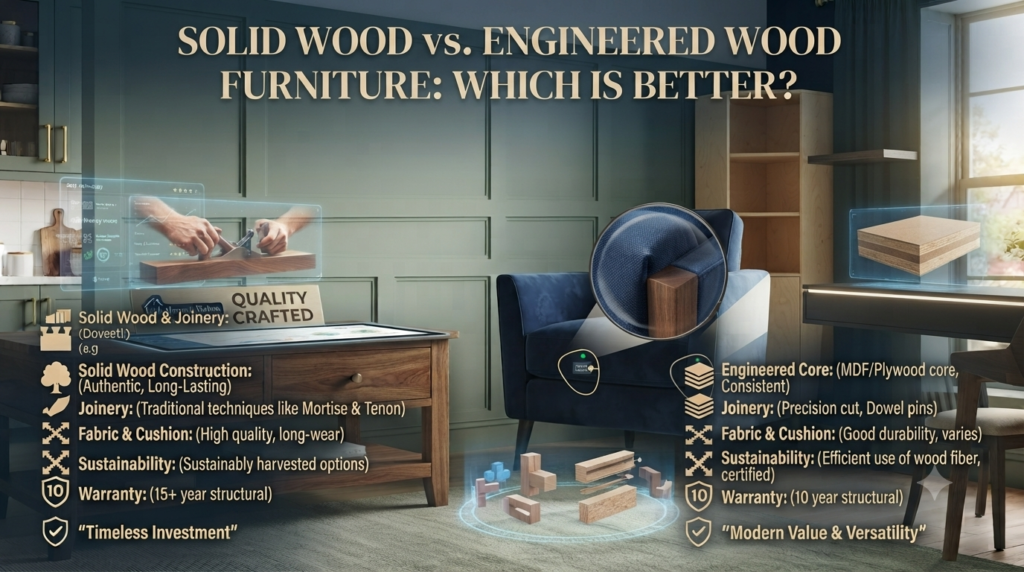
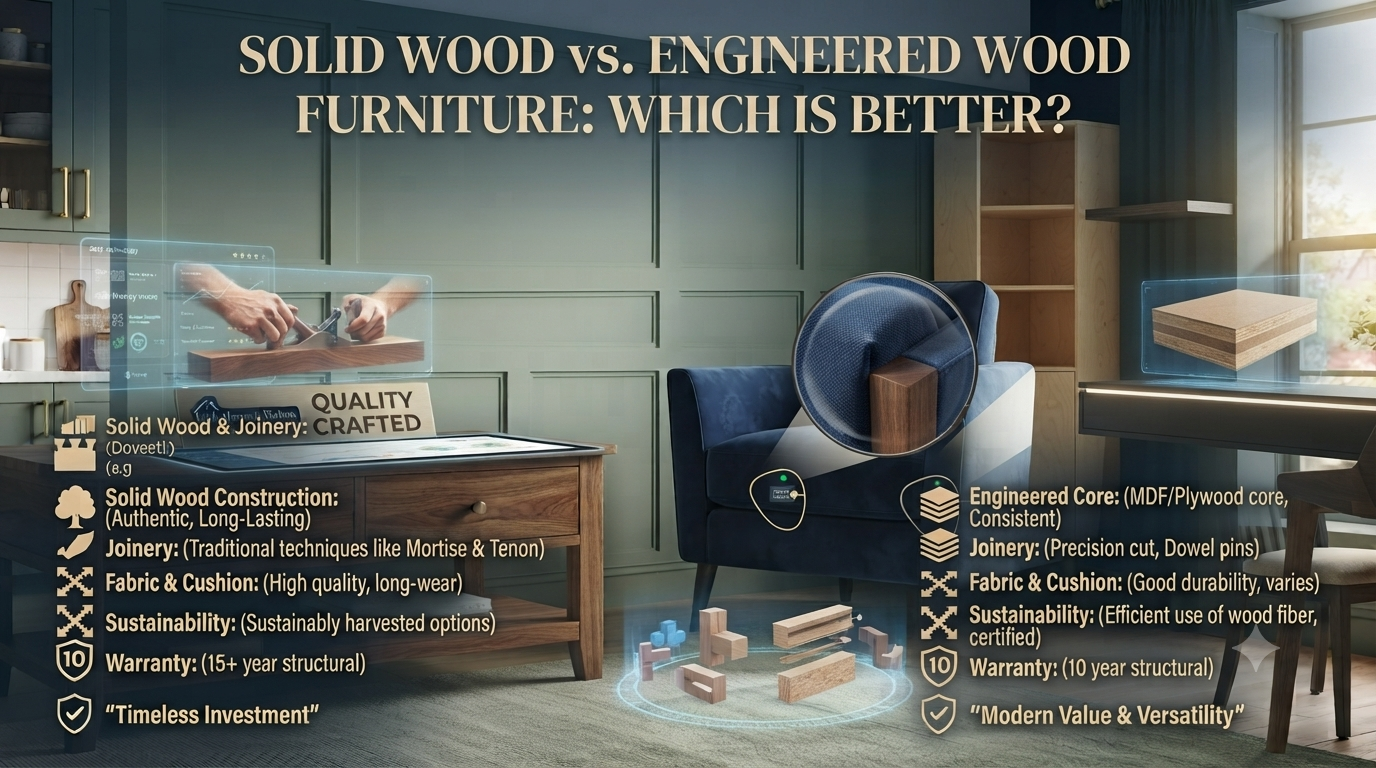
Solid Wood vs. Engineered Wood Furniture: Which Is Better?
When shopping for furniture, you are often faced with a choice that dictates how your home looks, feels, and performs for decades: solid wood or engineered wood. At first glance, a dining table or wardrobe may look identical on a retail website, yet one is milled directly from harvested timber while the other is manufactured by binding wood fibers, particles, or veneers under intense heat and pressure.
At Homes & Kitchens, we believe in Knowledge Before Products and Research Before Opinion. Understanding what lies beneath the surface finish is essential for making a sound investment. Choosing between these materials is not about finding a single “superior” option; it is about matching the physical properties of the material to your room’s environment, your daily household habits, and your long-term expectations.
Defining the Materials: What Are They Really?
To understand how furniture behaves under daily household stress, we must first examine how both material types are produced.
[Natural Timber Logs] ──(Sawing & Kiln-Drying)──> [Solid Wood Components]
[Wood Fibers/Veneers] ──(Resin & Compression)──> [Engineered Wood Panels]
1. Solid Wood
Solid wood refers to lumber that comes directly from trees. Once felled, the timber is sawn into boards and carefully kiln-dried to reduce internal moisture. Common hardwoods used in quality furniture include oak, maple, walnut, cherry, and teak, while softer species like pine are utilized for rustic designs.
- The Structural Reality: Solid wood retains its natural cellular structure. It has distinct grain patterns, responds organically to changes in atmospheric humidity, and carries a substantial physical weight that anchors a room.
2. Engineered Wood
Engineered wood encompasses a broad category of man-made composite materials created by binding wood veneers, strands, particles, or fibers with synthetic resins and adhesives.
- Plywood: Manufactured by cross-laminating thin sheets (plies) of wood veneer under high pressure. Its alternating grain direction provides immense structural stability.
- Medium-Density Fiberboard (MDF): Made by breaking down hardwood or softwood residuals into fine wood fibers, combining them with wax and resin, and pressing them into dense, ultra-smooth panels.
- Particleboard: Formed by pressing wood chips, sawmill shavings, and resin together. It represents the most budget-friendly and least structurally resilient category of engineered wood.
Comprehensive Head-to-Head Comparison
| Performance Factor | Solid Wood | Engineered Wood (Plywood / MDF) |
| Durability & Lifespan | Decades to generations; highly resistant to structural breakdown. | Varies from 10 to 30 years (plywood lasts longer; particleboard degrades faster). |
| Moisture & Humidity Response | Expands and contracts; susceptible to cracking or warping if unsealed in extreme humidity. | Generally more dimensionally stable; resists seasonal warping better, but swells if water penetrates cores. |
| Repairability | Exceptional; can be sanded down, patched, and refinished multiple times. | Limited; surface veneers can scratch, and water-damaged particleboard or MDF is usually irreparable. |
| Weight & Handling | Heavy, dense, and solid; difficult to transport or reconfigure frequently. | Lighter and easier to assemble, ship, and move across rooms. |
| Cost Investment | Premium price tier due to raw material harvesting, processing, and skilled joinery. | Budget-friendly to mid-range; efficient manufacturing reduces material waste. |
| Indoor Air Quality | Naturally inert; emits no synthetic volatile organic compounds (VOCs). | May off-gas VOCs (such as formaldehyde) depending on the resins and binding adhesives used. |
Deep-Dive Analysis: Performance Across Living Spaces
Different rooms in a home place entirely unique physical demands on furniture. Analyzing how solid wood and engineered wood perform in specific environments will guide your purchasing framework.
In the Living Room: Coffee Tables and Media Consoles
The living room is a high-traffic hub where furniture encounters heavy objects, spills, and daily friction.
- Solid Wood Performance: A solid oak or walnut coffee table handles weight effortlessly. If a child or guest gouges the surface, the piece can be sanded down and refinished.
- Engineered Wood Performance: Media consoles often require large, flat panels that benefit from engineered wood’s dimensional stability. High-quality plywood back panels and MDF frames prevent bowing under heavy electronics, provided moisture is kept at bay. For structural layout insights, see our guide on Kitchen Cabinets Guide.
In the Dining Room: Tables and Seating
Dining tables are subjected to intense thermal shifts from hot serving dishes, moisture from spills, and constant pulling and pushing of chairs.
- Why Solid Wood Wins Here: Dining tables are classic heirloom candidates. Solid wood provides the structural rigidity needed for mortise-and-tenon joinery on table legs. It ages gracefully, developing a rich patina over decades.
- The Engineered Wood Alternative: Large dining tabletops made of solid wood can cup or crack if humidity swings wildly. Some premium manufacturers use engineered cores capped with a thick hardwood veneer to combine seasonal stability with authentic surface beauty.
In the Bedroom: Wardrobes and Bed Frames
Bedrooms require materials that offer stability, clean aesthetics, and healthy indoor air quality.
- Bed Frames: A bed frame must endure lateral stress and dynamic weight loads. Solid wood or high-grade structural plywood prevents squeaking and joint loosening over time.
- Wardrobes and Closets: Large wardrobes benefit greatly from engineered wood panels because massive solid wood doors are prone to warping under their own weight unless reinforced with specialized iron turnbuckles.
Common Mistakes to Avoid When Buying Wood Furniture
Navigating furniture retail requires vigilance. Avoid these common consumer missteps:
- Mistake 1: Assuming “solid wood” means every single component is 100% natural timber.
- Correction: Some manufacturers label a piece as solid wood while using veneer over particleboard for internal panels or drawer bottoms. Always check full product specifications.
- Mistake 2: Overlooking the dangers of low-density particleboard in high-moisture zones.
- Correction: Placing a cheap particleboard bathroom vanity or basement cabinet in a humid environment will cause the core to absorb ambient moisture, swell up, and disintegrate.
- Mistake 3: Neglecting indoor humidity control.
- Correction: Exposing solid wood furniture to extreme winter heating or summer humidity swings without a humidifier or air conditioner causes severe splitting and joint separation.
- Mistake 4: Failing to check VOC safety certifications for engineered boards.
- Correction: Budget engineered furniture can release formaldehyde gas. Look for CARB Phase 2 compliance or TSCA Title VI certified low-emission panels.
Maintenance and Care Guidance
Maximizing the lifespan of your furniture requires tailored maintenance routines based on its core composition.
- Caring for Solid Wood:
- Clean spills immediately using a damp microfiber cloth, followed by a dry cloth.
- Apply a natural beeswax or furniture oil annually to nourish the wood fibers and prevent drying.
- Keep pieces away from direct heat vents and intense sunlight to avoid fading and cracking.
- Caring for Engineered Wood:
- Never saturate veneered or laminated surfaces with water; excess moisture seeping into exposed edge-banding will cause delamination.
- Use felt pads under heavy objects to prevent scratching the thin protective top layer.
- Tighten cam-locks and hardware periodically, as engineered boards can loosen around metal fasteners under heavy stress.
Frequently Asked Questions
Which lasts longer, solid wood or engineered wood furniture?
Solid wood lasts significantly longer—often spanning multiple generations (decades to centuries) because it can be repeatedly sanded and refinished. Engineered wood typically has a lifespan of 10 to 30 years depending on core quality.
Is engineered wood cheaper than solid wood?
Yes, engineered wood is generally much more affordable because it utilizes wood scraps, sawdust, and fast-growing fibers, reducing raw material and processing costs.
Does engineered wood warp in high humidity?
Engineered wood (particularly high-grade plywood and MDF) is much more dimensionally stable than solid wood and resists seasonal warping, making it popular for kitchens and humid climates. However, prolonged water contact causes severe swelling.
Can you refinish engineered wood furniture?
Generally, no. Standard engineered furniture features a very thin paper or wood veneer. Sanding it will quickly breach the top layer and expose the underlying composite core.
Why does solid wood furniture crack?
Solid wood cracks when it loses or absorbs moisture too rapidly, causing internal stresses. Proper kiln-drying and controlled indoor humidity largely eliminate this risk.
Is plywood considered a type of engineered wood?
Yes. Plywood is an engineered wood product made by cross-laminating multiple layers of wood veneer under heavy pressure, giving it exceptional structural strength.
Does solid wood furniture emit toxic chemicals?
No. Natural solid wood is free from synthetic resins, making it entirely free from formaldehyde off-gassing and ideal for sensitive indoor environments.
How can you tell if furniture is solid wood or veneer?
Inspect the grain patterns on edges and corners. If the grain loops continuously from the top surface down the side edge, it is likely solid wood. If the grain patterns abruptly stop or mismatch at the seams, it is a veneer.
Is particleboard safe to use in homes?
Particleboard is safe if it meets strict low-emission standards (such as CARB Phase 2 or E0 ratings). However, it lacks structural strength and should be avoided for weight-bearing joints.
How do I protect solid wood from water rings?
Always use coasters under drinks, place felt pads under hot serving dishes, and ensure the wood has a protective polyurethane, lacquer, or wax seal.
Can solid wood furniture be used outdoors?
Only specific weather-resistant hardwoods like teak, acacia, or eucalyptus can withstand outdoor elements. Standard indoor solid wood will quickly degrade outside.
What is edge-banding on engineered wood?
Edge-banding is a thin strip of PVC, melamine, or wood veneer glued to the exposed raw edges of engineered panels to protect the core from moisture and physical damage.
Which material is better for heavy books on a bookshelf?
Plywood or solid wood is superior for heavy book storage. MDF and particleboard shelves will bow and sag permanently under heavy loads over time.
Does solid wood furniture increase home resale value?
While furniture rarely conveys with real estate unless specified, investing in heirloom-quality solid wood pieces adds enduring functional and aesthetic value to your household inventory.
How does manufacturing solid wood impact the environment?
Solid wood harvesting can impact forests if mismanaged, but choosing FSC-certified (Forest Stewardship Council) or reclaimed timber ensures responsible, sustainable forestry practices.
Conclusion
Choosing between solid wood and engineered wood furniture comes down to balancing your budget, lifestyle demands, and design expectations. Solid wood offers unmatched generational durability, natural beauty, and repairability, making it the ideal investment for heavy-use pieces like dining tables and bed frames. Engineered wood provides exceptional dimensional stability, budget-friendly versatility, and resistance to warping, making it a smart choice for large flat panels, modern cabinetry, and modular wardrobes. By understanding their structural traits, you can curate a home filled with pieces built to last.
Key Takeaways
- Match material to function: Use solid wood for high-stress joints and heirloom pieces, and engineered wood for large flat panels and budget-conscious cabinetry.
- Prioritize structural integrity: Inspect core specifications rather than relying solely on exterior visual finishes.
- Manage indoor climate: Protect solid wood from rapid humidity shifts and shield engineered wood from standing water.
- Invest with longevity in mind: Evaluate total cost over time—paying more upfront for solid wood often eliminates premature replacement cycles.
Ready to make your next furniture investment? Take stock of your room layouts, assess your household moisture levels, and choose the material foundation thatbrings both beauty and structural reliability to your home.