Introduction
When your refrigerator stops cooling mid-summer or your washing machine starts making a sound resembling a jet engine taking off, the immediate realization is clear: appliance reliability matters more than sleek marketing or flashy digital touchscreens.
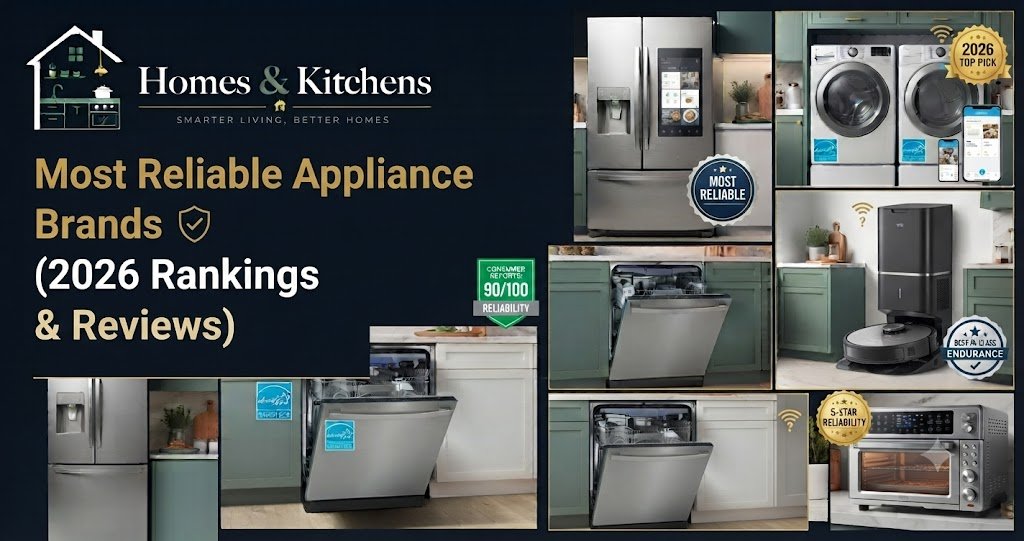
Shopping for major home appliances—such as refrigerators, dishwashers, ranges, and laundry suites—requires looking past showroom aesthetics. You need to know which manufacturers build machines that endure years of daily wear and tear, and which brands spend more time in repair queues than serving your household.
To establish our 2026 rankings, we analyzed annual field service data from major independent repair networks, consumer satisfaction indices, long-term lab evaluations, and failure rate tracking. This guide breaks down the top-performing appliance brands, identifies where specific manufacturers excel, and highlights what you should look for before making a significant investment.
What Makes an Appliance Brand Truly Reliable?
Reliability is rarely about a single standout feature. Instead, it is the result of engineering philosophy, manufacturing consistency, and part accessibility. When industry experts evaluate an appliance brand, they look at several foundational metrics:
- First-Year Service Rates: The percentage of units that require a technician visit within the first 12 to 36 months of ownership. Top-tier brands maintain low single-digit service rates.
- Mechanical Simplicity vs. Over-Engineering: Appliances packed with complex computer boards, Wi-Fi modules, and multi-zone sensors present more points of failure than mechanically straightforward units.
- Component Quality: The durability of internal parts—such as brass fittings instead of plastic connectors, stainless steel tubs instead of polypropylene, and brushless inverter motors.
- Parts and Service Availability: How quickly a manufacturer supplies replacement parts to local technicians, ensuring a broken machine is fixed in days rather than months.
The 2026 Reliability Tier List
Appliance brands span a wide spectrum from mass-market utility to ultra-luxury custom builds. Based on aggregate service data and consumer satisfaction surveys, we can categorize the leading brands into four distinct reliability tiers.
| Reliability Tier | Defining Characteristics | Representative Brands |
| Tier 1: Elite Reliability | Exceptionally low failure rates, premium engineering, and long service lives. | Bosch, Miele, Fisher & Paykel |
| Tier 2: Highly Dependable | Sturdy engineering, straightforward mechanics, and easy repair access. | Whirlpool, GE Appliances, KitchenAid |
| Tier 3: Feature-Rich Average | High innovation and strong performance, but higher service call frequencies. | LG, Samsung, GE Profile |
| Tier 4: Specialized / Niche | Ultra-luxury styling with intricate technical demands requiring specialized care. | Sub-Zero, Wolf, Thermador |
Detailed Brand Reviews: Who Leads the Market in 2026?
1. Bosch: The Gold Standard for Kitchens
Bosch has built its reputation on precision German engineering, quiet operation, and remarkably low repair frequencies.
- Where They Excel: Dishwashers and compact kitchen appliances. Bosch 800 Series dishwashers consistently rank at the top of independent lab tests and service data logs for longevity and silent operation.
- The Catch: Premium pricing and higher costs for replacement parts if service is required out-of-warranty.
2. GE Appliances: America’s Broad Workhorse
Backed by strong national service networks and proven platform designs, GE Appliances (including GE Profile) continues to score exceptionally high across consumer satisfaction and reliability metrics, earning top honors in major U.S. reliability studies for refrigerators, cooking appliances, and laundry suites.
- Where They Excel: Side-by-side and French door refrigerators, freestanding ranges, and top-load/front-load laundry pairs.
- The Catch: Entry-level models can feel slightly more utilitarian in exterior finish compared to luxury design brands.
3. Whirlpool: The King of Repairability
Whirlpool relies on a philosophy of straightforward engineering. By avoiding unnecessary electronic gimmicks and focusing on robust mechanical assemblies, Whirlpool remains a favorite recommendation among independent appliance repair technicians.
- Where They Excel: Laundry pairs (washers and dryers) and kitchen essentials. Their shared component ecosystem (spanning Maytag and Amana) ensures parts are readily available nationwide.
- The Catch: Styling tends to be more conservative, prioritizing function over sleek architectural minimalism.
4. LG: Innovation Meets Efficiency
LG commands a massive footprint in the American market, pairing modern aesthetics with highly efficient inverter compressors and direct-drive washing machine motors.
- Where They Excel: Laundry performance and refrigerator temperature uniformity. LG front-load washers consistently lead consumer testing guides for cleaning power and fabric care.
- The Catch: Historical challenges with linear compressor longevity in earlier refrigerator generations required careful monitoring, though recent manufacturing updates have improved structural reliability.
5. Samsung: Tech-Forward Convenience
Samsung appeals directly to smart-home enthusiasts who want deep ecosystem integration, app controls, and innovative storage configurations.
- Where They Excel: Smart refrigerators, connected laundry cycles, and modern kitchen styling. Samsung frequently tops customer satisfaction awards for feature sets and ease of use.
- The Catch: Complex smart touchscreens and advanced control boards experience higher initial service call rates than simpler analog machines.
Best Appliance Brand by Category
If you are mixing and matching brands for a kitchen remodel or utility room update, optimizing by category yields the best long-term results.
| Appliance Category | Top Recommended Brand | Key Reliability Factor |
| Dishwasher | Bosch | Sealed stainless tubs, leak protection, low filter failure rates |
| Refrigerator | GE / LG | Stable compressor cooling, dependable digital temperature controls |
| Washing Machine | Whirlpool / LG | Balanced drum suspension, robust direct-drive or belt motors |
| Clothes Dryer | Maytag / GE | Durable heating elements and accessible lint filtration paths |
| Cooking Range | GE Profile | Consistent ignition modules and reliable oven thermal sensors |
Common Mistakes That Ruin Appliance Reliability
Even the most reliable appliance on the market can fail prematurely if installed or maintained incorrectly. Avoid these common pitfalls:
- Neglecting Routine Cleaning: Failing to vacuum refrigerator condenser coils or clean out dishwasher filters forces motors and compressors to overheat, leading to premature burnout.
- Overloading Laundry Drums: Stuffing a washer or dryer past its rated capacity strains drum bearings, suspension springs, and drive belts.
- Skipping Surge Protection: Connecting high-end appliances with integrated microprocessors directly to unprotected wall outlets leaves them vulnerable to minor electrical spikes and grid fluctuations.
- Ignoring Leveling Instructions: Installing a washing machine or refrigerator on an uneven floor creates chronic vibrational stress that damages internal mechanical components over time.
Frequently Asked Questions
1. Which appliance brand requires the fewest repairs overall?
According to aggregated field data from independent service technicians and consumer reports, Bosch (for dishwashers and cooking) and Whirlpool/Miele (for general utility) consistently report the lowest incidence of unexpected mechanical breakdowns.
2. Are expensive luxury appliances more reliable than mid-tier brands?
Not necessarily. While ultra-luxury brands offer exceptional materials and custom aesthetics, they often pack in complex, proprietary electronics and multi-zone cooling systems that require specialized servicing and generate higher failure rates than mass-market workhorses.
3. Do extended warranties make up for a brand’s poor reliability?
In most cases, extended warranties are unnecessary financial padding for retailers. Major appliances come with a standard 1-year manufacturer warranty, and many credit cards extend this coverage by an additional year. If a brand has a notoriously high failure rate, an extended warranty becomes a hassle of repeated service appointments rather than a fix for poor engineering.
4. How can I verify local service availability before buying a brand?
Before purchasing an imported or specialized brand, check your local area for factory-certified technicians. Even the most reliable machine will require a repair eventually, and waiting weeks for a technician to travel from another region can leave you stranded.
Final Verdict
Choosing a reliable home appliance brand means balancing your desire for advanced features with the reality of long-term mechanical durability. If your priority is peace of mind, low repair frequencies, and simple maintenance, brands like Whirlpool, GE, and Bosch represent the safest, most data-backed investments for your home. If you value cutting-edge smart integration and modern aesthetic versatility, brands like LG and Samsung offer compelling options, provided you account for their slightly higher technical complexity.
Conclusion
Investing in reliable home appliances safeguards your daily routine against unexpected headaches and expensive repair bills. By focusing on proven engineering, matching brands to their strongest individual categories, and committing to basic annual maintenance, you ensure your home infrastructure operates smoothly for years to come.
For further guidance on building your ideal living space, explore our related resources on Kitchen Remodel Cost Guide, Kitchen Cabinets Guide, and Countertop Materials.