
Introduction
Few home improvement projects evoke as much excitement—or as much financial anxiety—as a kitchen remodel. As the undisputed heart of the home, the kitchen is where daily routines unfold, family gatherings center, and long-term memories are made. It is also the most complex, utility-heavy, and expensive room in any house to update.
National estimates indicate that a typical kitchen remodel costs anywhere from $15,000 for a minor cosmetic refresh to over $80,000 for a full-scale, upscale structural renovation, with national mid-range averages sitting comfortably around $27,000 to $45,000. However, raw averages rarely tell the whole story. A compact galley kitchen in a suburban home requires a vastly different financial commitment than a sprawling open-concept kitchen in a metropolitan area where labor rates and material logistics shift dramatically.
Navigating a kitchen renovation without a transparent roadmap can lead to budget blowouts, contractor friction, and choice fatigue. This comprehensive guide cuts through the noise. We will examine granular cost breakdowns by room size, material, and labor tier, analyze hidden expenses, and provide actionable strategies to protect your hard-earned dollars. Knowledge is your best tool for building a stunning kitchen without breaking the bank.
2026 National Cost Overview: What to Expect
Before opening a catalog or calling a general contractor, you need a realistic baseline of current market pricing. Costs have shifted over recent years due to fluctuating material expenses and labor demands.
The table below outlines the primary remodeling tiers, what they typically include, and the financial investment required.
| Remodel Tier | Average Cost Range | Scope of Work | Best For |
| Minor / Cosmetic | $15,000 – $25,000 | Painting cabinets, updating hardware, new laminate or quartz countertops, backsplash tile, simple light fixtures, keeping existing layout. | Homeowners looking for a fresh look with minimal disruption and lower ROI risk. |
| Mid-Range / Full Update | $30,000 – $75,000 | Semi-custom cabinets, mid-tier stone countertops, full appliance package, new flooring, updated electrical and plumbing fixtures. | Long-term homeowners modernizing a dated, inefficient space without altering walls. |
| Major / High-End | $100,000 – $160,000+ | Structural changes (moving walls), custom floor-to-ceiling cabinetry, high-end professional appliances (e.g., Sub-Zero, Wolf), luxury slab countertops, custom lighting layout. | Forever homes or luxury properties where maximizing personal design and culinary utility is the primary goal. |
Detailed Cost Breakdown by Kitchen Component
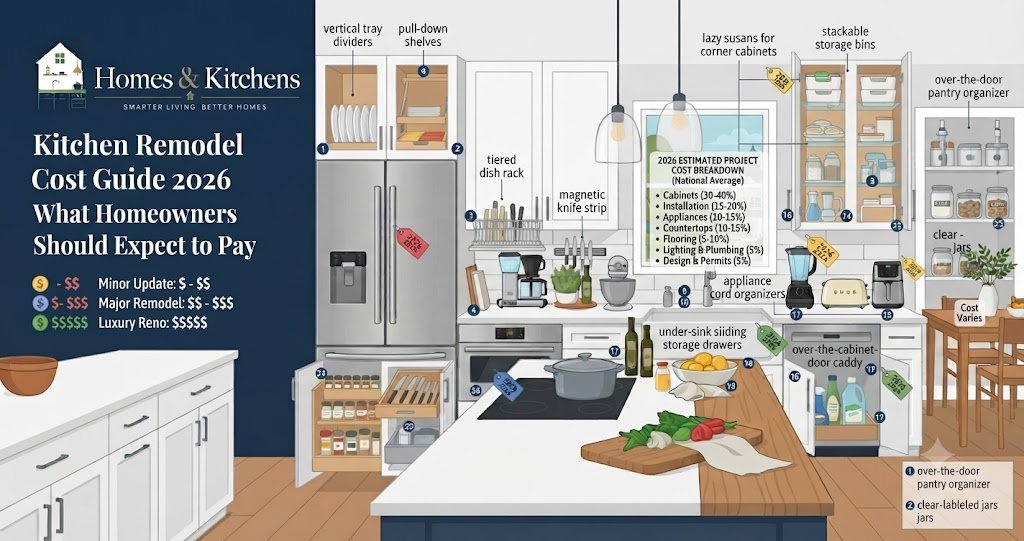
Understanding where your money goes is essential for making smart compromises. In any standard kitchen remodel, budget distribution follows a relatively predictable pattern.
[ Cabinets & Hardware: 30% - 40% ]
[ Labor & Installation: 20% - 35% ]
[ Appliances & Fixtures: 10% - 20% ]
[ Countertops: 10% - 15% ]
[ Flooring, Lighting & Permits: 10% - 15% ]
1. Kitchen Cabinetry (30% to 40% of Budget)
Cabinets consume the largest single share of a kitchen renovation budget. How you choose to handle your cabinetry will dictate the financial trajectory of your entire project.
- Stock Cabinets ($100 to $300 per linear foot): Pre-manufactured in standard sizes, stock cabinets are budget-friendly and available off-the-shelf. The trade-off is limited finish options and sizing constraints that may require filler strips.
- Semi-Custom Cabinets ($200 to $650 per linear foot): Offering a middle ground, these are built after you order them, allowing for a wider selection of wood species, door styles, depths, and organizational inserts.
- Custom Cabinets ($500 to $1,500+ per linear foot): Handcrafted by local artisans or specialized millwork shops to fit exact architectural quirks. They provide limitless design possibilities but can easily push past $25,000 for a large kitchen.
- Cabinet Refacing ($4,000 to $9,000 total): If your cabinet boxes are structurally sound plywood, keeping the boxes while replacing doors, drawer fronts, and hardware cuts material costs by nearly half.
2. Countertops (10% to 15% of Budget)
Countertops define the visual weight of your kitchen workspace. Pricing is generally calculated per square foot, inclusive of fabrication, edge profiles, and cutout work for sinks and cooktops.
- Laminate ($20 to $60 per sq. ft.): Modern high-definition laminates mimic stone surprisingly well and offer an economical, low-maintenance surface for budget builds.
- Butcher Block ($40 to $100 per sq. ft.): Warm, organic, and DIY-friendly, wood counters require periodic mineral oil sealing but add immense character.
- Granite ($60 to $120 per sq. ft.): A natural stone classic that offers exceptional heat resistance and durability, though it requires periodic sealing.
- Quartz / Engineered Stone ($70 to $150 per sq. ft.): Non-porous, highly durable, and requiring zero sealing, quartz remains the reigning champion for modern family kitchens.
3. Appliances (10% to 20% of Budget)
Appliance packages vary based on whether you are replacing individual units or buying an integrated suite.
- Budget Package ($2,000 to $4,000): Standard freestanding range, top-freezer refrigerator, built-in dishwasher, and over-the-range microwave.
- Mid-Range Package ($5,000 to $10,000): Stainless steel appliances featuring slide-in ranges, French-door refrigerators, quiet dishwashers, and distinct ventilation hoods (brands like GE Profile, Bosch, KitchenAid).
- Professional Grade ($20,000 to $50,000+): Commercial-style gas ranges, built-in column refrigeration, paneled dishwashers, and specialty beverage centers (brands like Sub-Zero, Wolf, Thermador).
4. Labor, Permits, and Design Fees (20% to 35% of Budget)
Labor is non-negotiable, and skimping here often results in code violations or poor craftsmanship.
- General Contractors: Typically charge a 15% to 20% markup on total project costs if managing all trades (plumbers, electricians, drywallers, tilers).
- Hourly Trades: Specialized electricians and plumbers generally bill between $90 and $150 per hour depending on geographic market.
- Permits: Ranging from $500 to $2,000, building, electrical, and plumbing permits protect your investment and are legally required for structural or utility alterations.
Hidden Costs Every Homeowner Forgets
The fastest way to blow a renovation budget is failing to account for hidden expenses. When planning your financing, always pad your total estimate by 15% to 20% as an emergency contingency fund.
- Temporary Kitchen Setup: If your sink, stove, and refrigerator are out of commission for 6 to 10 weeks, factor in the cost of takeout, paper goods, and a makeshift basement or dining room kitchenette.
- Out-of-Code Electrical Updates: If you open walls in an older home, local building codes may require upgrading your entire electrical system to include ground-fault circuit interrupter (GFCI) protection, dedicated 20-amp appliance circuits, or a main electrical panel upgrade ($1,500 to $3,500).
- Subfloor Remediation: Once old linoleum or tile is ripped up, contractors frequently discover water-damaged or uneven subflooring that must be repaired before new hardwood or tile can be laid.
- Trash Disposal and Dumpster Rental: Renting a 20-yard roll-off dumpster for construction debris costs between $400 and $700 depending on your municipality.
Smart Ways to Save Money on Your Kitchen Remodel
You do not need an unlimited budget to achieve a high-end look. Strategic compromises can save thousands of dollars without sacrificing daily utility.
- Keep Your Footprint Intact: Moving the kitchen sink across the room requires rerouting supply lines, waste vents, and concrete trenching. Keeping your sink, stove, and refrigerator in their original locations saves thousands in plumbing and electrical rough-in labor.
- Mix Premium and Budget Materials: Splurge on a durable quartz island countertop where everyone gathers, but use a cost-effective laminate or butcher block along perimeter walls.
- Choose Semi-Custom Over Custom: Modern semi-custom cabinet lines offer 90% of the aesthetic and organizational flexibility of fully custom builds at a fraction of the cost.
- Sweat Equity (DIY Where Safe): Homeowners with basic skills can safely handle selective demolition, wall painting, backsplash tiling, and hardware installation, leaving complex electrical and gas line connections to licensed professionals.
When to Hire a Professional vs. DIY
While the DIY ethos is admirable, kitchen remodels involve intricate structural, safety, and regulatory elements.
| Task | DIY Feasibility | Professional Recommendation | Why? |
| Demolition | High | Safe for homeowners | Saves labor costs if you have a truck, safety gear, and time. |
| Painting & Hardware | High | Safe for homeowners | High labor cost savings for surface-level updates. |
| Backsplash Tiling | Medium | Moderate | Requires patience and precision around cuts, outlets, and corners. |
| Countertop Templating & Install | Low | Mandatory Pro | Heavy stone slabs require specialized lifting equipment and precise laser measuring. |
| Electrical & Gas Lines | Low | Mandatory Pro | Fire and carbon monoxide hazards mean code compliance and permits are strictly required. |
| Structural Wall Removal | None | Mandatory Pro | Removing load-bearing walls without proper temporary shoring and engineered beams can cause roof sagging or structural failure. |
Frequently Asked Questions
1. How long does an average kitchen remodel take?
A minor cosmetic refresh takes 2 to 4 weeks. A standard mid-range renovation involving new cabinets and finishes takes 6 to 10 weeks. A major gut renovation involving structural wall removal can easily span 12 to 16 weeks from initial demo to final cleanup.
2. What is the return on investment (ROI) for a kitchen remodel?
According to national cost-vs-value data, a minor mid-range kitchen remodel recoups roughly 80% to 95% of its cost upon home resale. Major upscale renovations see a lower percentage return (around 35% to 50%) because custom luxury features cater to specific personal tastes rather than broad market appeal.
3. Should I buy appliances before or after hiring a contractor?
Always select and spec your appliances before finalizing your kitchen cabinet layout. Appliance dimensions—particularly refrigerator depths and pro-style range widths—dictate cabinet clearances and panel sizes.
4. How can I survive living in a house during a kitchen remodel?
Set up a temporary kitchen in a nearby room or basement using a microwave, toaster oven, electric kettle, and a mini-fridge. Wash dishes in a bathroom or laundry sink, and pack away essential dishes and utensils in labeled plastic storage bins.
5. Do I need an architect or interior designer?
If you are modifying load-bearing walls, expanding the home footprint, or changing window and door placements, an architect or structural engineer is required. For layout planning, material selection, and lighting coordination, an experienced kitchen designer can save you from costly layout mistakes.
Final Verdict & Key Takeaways
A kitchen remodel is a major financial undertaking, but it is also one of the few home improvements that fundamentally enhances your daily quality of life while anchoring your home’s equity.
- Budget Realistically: Expect to invest between $30,000 and $75,000 for a true mid-range update, and always add a 20% contingency buffer for surprises behind the walls.
- Preserve the Layout: Keeping your sink and range in their original zones is the single most effective way to protect your budget.
- Prioritize Function First: Invest your money in high-touch, heavy-use items like durable cabinetry hardware, reliable appliances, and resilient countertops.
By planning ahead, respecting your financial parameters, and knowing when to call in licensed professionals, you can navigate your kitchen renovation with clarity, confidence, and peace of mind.