The kitchen is the hardest-working room in your home. It is a prep station, a homework hub, an early-morning coffee bar, and late-night gathering space. Yet, it is often crippled by a single, lazy design choice: the dreaded “boob light”—a single flush-mount dome fixture centered in the ceiling that casts harsh shadows directly behind your back as you chop vegetables at the counter.
Good kitchen design starts with light. If you cannot see what you are cutting, or if your space feels like a dim cave despite your best decor efforts, the issue is rarely square footage or paint color. It is your lighting plan.
Illumination is not just about making a room bright; it is about architecture, safety, mood, and efficiency. This comprehensive guide walks you through the physics of illumination, the art of layering, room-by-room layout strategies, fixture selection, and hands-on maintenance so you can build a brilliant, functional culinary workspace from the ground up.
1. The Foundation: Understanding Kitchen Lighting Layers
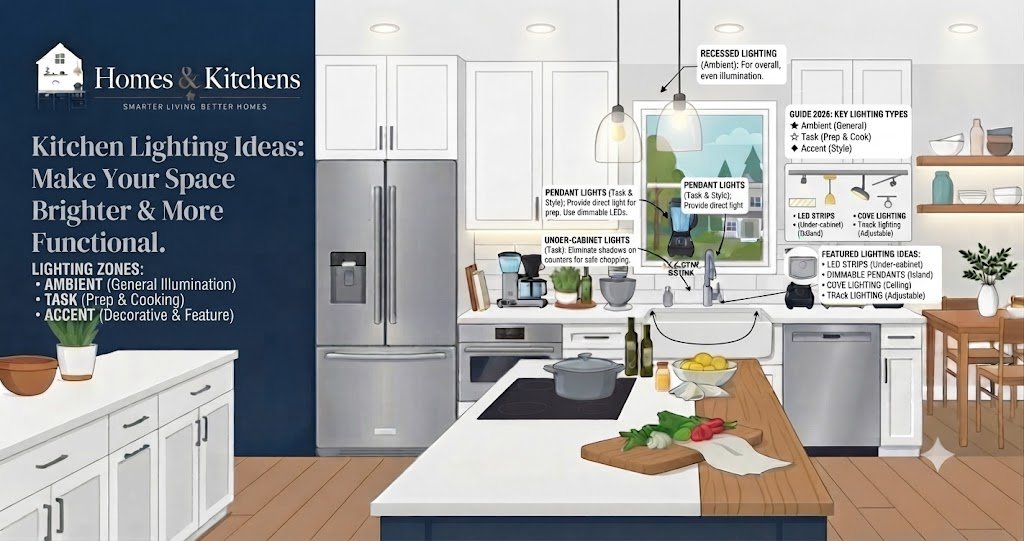
A professional kitchen lighting plan never relies on a single light source. Instead, it uses a concept known as layered lighting. By combining three distinct types of illumination, you eliminate dark corners, reduce eye strain, and give yourself absolute control over the mood of the room.
+-----------------------------------------------------------------+
|                       LAYERED LIGHTING PLAN                     |
+-----------------------------------------------------------------+
| 1. Ambient Lighting   -> The foundational, overall room glow.   |
| 2. Task Lighting      -> Focused, high-lumen light for work.    |
| 3. Accent Lighting    -> Decorative touches & architectural glow.|
+-----------------------------------------------------------------+
Ambient Lighting (The Foundation)
Ambient lighting provides overall illumination, filling in the gaps between natural light and task zones. It ensures you can safely walk through the kitchen without stumbling over a misplaced Dutch oven.
- Common Fixtures: Recessed downlights, flush or semi-flush ceiling mounts, large chandeliers, and perimeter track lighting.
- Placement Rule: Recessed cans should be spaced evenly across the ceiling, typically positioned about half the ceiling height apart (e.g., eight feet apart for an eight-foot ceiling), kept roughly two to three feet away from upper cabinets to prevent casting shadows on counter workspaces.
Task Lighting (The Workhorse)
Task lighting is targeted, high-intensity illumination directed at areas where detailed, potentially hazardous work takes place. This includes chopping vegetables at the countertop, monitoring boiling water on the range, and washing dishes in the sink.
- Common Fixtures: Under-cabinet LED strips, directional gimbal recessed lights, pendant lights over islands, and adjustable wall sconces.
- Why It Matters: Without task lighting, your body blocks the ambient ceiling light whenever you stand at the counter, plunging your cutting board into shadow. Task lighting brings the light source down to where the work happens.
Accent Lighting (The Character Builder)
Accent lighting adds depth, drama, and dimension. It draws the eye to architectural features, breaks up monotonous stretches of cabinetry, and creates a warm, inviting glow during evening hours.
- Common Fixtures: Inside-cabinet glass-front display lights, toe-kick strip lighting, picture lights over open shelving, and cove lighting.
- Design Impact: Toe-kick lighting acts as an exceptional nightlight while making heavy floor cabinets appear to float off the ground, instantly modernizing an older kitchen layout.
2. Technical Specifications: Lumens, Kelvins, and CRI
Before shopping for fixtures, you must understand the technical metrics of modern bulbs. Throw away everything you knew about incandescent wattages; today, lighting is measured by output, color warmth, and color accuracy.
Lumens vs. Watts
- Watts measure energy consumption (how much electricity the bulb draws).
- Lumens measure actual light output (how bright the bulb appears to the human eye).
For a standard kitchen, aim for an overall output of roughly 30 to 40 lumens per square foot. For a 150-square-foot kitchen, you will want a total output capacity of around 4,500 to 6,000 lumens distributed across your various fixtures.
Color Temperature (The Kelvin Scale)
Color temperature describes how warm (yellow) or cool (blue) a light source appears, measured in Kelvin ($K$).
- Warm White (2700K): Creates a cozy, traditional, yellowish glow. Excellent for traditional wood-toned kitchens and evening ambiance.
- Neutral White (3000K to 3500K): The sweet spot for modern kitchens. It renders colors accurately without feeling clinical or sterile. It complements both warm wood grains and crisp quartz countertops.
- Cool White / Daylight (4000K to 5000K): Crisp, bluish-white light that mimics overcast daylight. While great for commercial prep stations, it can make residential kitchens feel harsh and institutional unless balanced carefully.
Color Rendering Index (CRI)
CRI measures how accurately a light source reveals true colors compared to natural sunlight, scored on a scale from 0 to 100.
- In a kitchen, where you judge the ripeness of produce, check meat doneness, and match paint or tile undertones, always choose bulbs with a CRI of 90 or higher. A low-CRI bulb (below 80) will make fresh vegetables look dull and gray.
3. Zone-by-Zone Kitchen Lighting Ideas
Every zone in your kitchen serves a unique purpose and requires a tailored lighting approach.
Kitchen Island
- Purpose: Food preparation, dining, and entertaining
- Primary Lighting Type: Task & Decorative
- Recommended Fixtures: Pendant lights or linear suspension fixtures
- Color Temperature: 2700K–3000K (Warm White)
- Recommended Brightness: 1,500–3,000 lumens
Countertops
- Purpose: Chopping, cooking, and meal preparation
- Primary Lighting Type: Task
- Recommended Fixtures: Under-cabinet LED strip lights or LED puck lights
- Color Temperature: 3000K–4000K (Neutral White)
- Recommended Brightness: 1,500–2,500 lumens
Kitchen Sink
- Purpose: Washing dishes and food preparation
- Primary Lighting Type: Task
- Recommended Fixtures: Mini pendant, adjustable wall sconce, or recessed light
- Color Temperature: 3000K–4000K
- Recommended Brightness: 700–1,200 lumens
Range / Cooktop
- Purpose: Safe cooking and food monitoring
- Primary Lighting Type: Task
- Recommended Fixtures: Range hood with integrated LED lighting or recessed downlight
- Color Temperature: 3000K–4000K
- Recommended Brightness: 700–1,500 lumens
Pantry & Storage
- Purpose: Finding and organizing stored items
- Primary Lighting Type: Ambient & Task
- Recommended Fixtures: Motion-sensor flush mount or LED ceiling light
- Color Temperature: 3000K–4000K
- Recommended Brightness: 800–1,500 lumens
Dining Area
- Purpose: Dining and entertaining
- Primary Lighting Type: Ambient & Decorative
- Recommended Fixtures: Chandelier, pendant light, or linear fixture
- Color Temperature: 2700K–3000K
- Recommended Brightness: 2,000–4,000 lumens
General Kitchen
- Purpose: Overall room illumination
- Primary Lighting Type: Ambient
- Recommended Fixtures: Recessed ceiling lights, flush mount fixtures, or LED ceiling panels
- Color Temperature: 3000K–3500K
- Recommended Brightness: 3,000–6,000 lumens
Breakfast Nook
- Purpose: Casual dining and reading
- Primary Lighting Type: Ambient
- Recommended Fixtures: Pendant light, small chandelier, or semi-flush mount
- Color Temperature: 2700K–3000K
- Recommended Brightness: 1,500–2,500 lumens
Open Shelving
- Purpose: Highlight décor and improve visibility
- Primary Lighting Type: Accent
- Recommended Fixtures: LED strip lights or shelf lighting
- Color Temperature: 2700K–3000K
- Recommended Brightness: 300–800 lumens
Glass Cabinets
- Purpose: Showcase glassware and decorative items
- Primary Lighting Type: Accent
- Recommended Fixtures: LED cabinet lights or mini LED spotlights
- Color Temperature: 2700K–3000K
- Recommended Brightness: 300–700 lumens
Toe Kick Area
- Purpose: Add nighttime visibility and ambiance
- Primary Lighting Type: Accent
- Recommended Fixtures: Waterproof LED strip lights
- Color Temperature: 2700K–3000K
- Recommended Brightness: 200–500 lumens
Inside Cabinets & Drawers
- Purpose: Make stored items easier to find
- Primary Lighting Type: Task
- Recommended Fixtures: Motion-sensor LED cabinet lights
- Color Temperature: 3000K–4000K
- Recommended Brightness: 200–600 lumens
4. Comprehensive Product Recommendations
Selecting reliable, high-performing fixtures saves you from premature burnout, flickering LEDs, and frustrating installation headaches. Here are our top-tested recommendations across major categories.
Best Overall Pendant: Rejuvenation Haleigh Wire Dome Pendant
- Why We Chose It: The Haleigh Wire Dome strikes the ideal balance between industrial durability and timeless farmhouse warmth. Its open wire cage allows maximum light dispersion while providing striking architectural silhouette lines.
- Key Specifications: Custom drop lengths available, heavy-gauge brass or steel construction, compatible with dimmable LED Edison bulbs up to 60W equivalent.
- Best For: Mid-century modern, transitional, and classic farmhouse kitchens.
- Approximate Price: $249 – $329
Best Budget Under-Cabinet Solution: Brilliant Evolution Wireless LED Puck Lights
- Why We Chose It: For renters or homeowners wanting an immediate upgrade without tearing into drywall or hiring an electrician, these battery-operated, tap- or remote-controlled pucks deliver exceptional, flicker-free task light at a fraction of the cost.
- Key Specifications: Warm white 3000K output, wireless remote control with auto-off timer, runs on standard AA batteries.
- Best For: Renters, DIY beginners, and budget-conscious updates.
- Approximate Price: $25 – $40 (pack of 6)
Best Premium Hardwired Under-Cabinet Option: Armacost Lighting RibbonFlex Pro LED Tape Light
- Why We Chose It: Professional cabinet installers and contractors swear by Armacost systems for their high CRI (95+), robust aluminum extrusion channels, and professional dimming compatibility. It delivers smooth, seamless, professional-grade illumination.
- Key Specifications: 24V DC system, dimmable with standard ELV dimmers, high color accuracy (CRI 95), cut-to-size flexibility.
- Best For: Full kitchen remodels, custom cabinetry projects, and design purists.
- Approximate Price: $90 – $150 (complete kit)
Best Smart Lighting Option: Philips Hue White and Color Ambiance Play Bars / Lightstrips
- Why We Chose It: If you love integrating smart home tech, Philips Hue offers unrivaled ecosystem reliability. You can program morning routines to shift from cool, energizing white to warm, inviting evening tones automatically, or sync lights with your kitchen audio setup.
- Key Specifications: Zigbee/Bluetooth compatible, works with Alexa, Google Assistant, and Apple HomeKit, 16 million color options.
- Best For: Smart home enthusiasts and modern open-concept spaces.
- Approximate Price: $80 – $180
5. Fixture Comparison Matrix
To help you weigh your options at a glance, the table below compares common kitchen lighting fixture types by cost, energy efficiency, installation complexity, and ideal placement.
| Fixture Type | Average Cost (Per Unit) | Energy Efficiency | Installation Complexity | Ideal Placement Zone | Dimmable? |
| Recessed Cans | $15 – $50 | High (LED) | Moderate to High (Wiring required) | General ambient ceiling grid | Yes (with compatible switch) |
| Pendant Lights | $50 – $400+ | High (LED) | Moderate (J-box required) | Kitchen islands, peninsulas | Yes |
| Under-Cabinet LEDs | $30 – $150 | High (LED) | Low to Moderate (Plug-in or Hardwired) | Countertop prep zones | Yes |
| Flush Mounts | $40 – $200 | High (LED) | Low to Moderate | Small kitchens, pantries, hallways | Yes |
| Track Lighting | $70 – $250 | High (LED) | Moderate (Single junction box) | Sloped ceilings, targeted wall art | Yes |
6. Modern Kitchen Lighting Trends (2026)
Design standards continue to evolve toward clean lines, minimalist concealment, and wellness-focused functionality.
- Linear Architectural Suspensions: Bulky, multi-globe chandeliers are giving way to sleek, minimalist linear bars that float effortlessly above large islands, providing uniform illumination without blocking sightlines across open-concept main floors.
- Integrated LED Profiles: Rather than bolting visible fixtures under cabinets, modern cabinet makers integrate LED channels directly into the wood construction during fabrication, hiding diodes completely behind frosted acrylic lenses.
- Tunable White Smart Lighting: Systems that automatically shift color temperature throughout the day—matching the cool blue tones of morning sunlight and transitioning to warm amber hues in the evening—help support natural human circadian rhythms.
- Statement Sconces over Open Shelving: Replacing upper wall cabinets with open wood shelving has made wall-mounted swing-arm sconces immensely popular, providing localized reading and prep light while serving as striking wall decor.
7. Common Kitchen Lighting Mistakes to Avoid
Even high-end kitchens can feel poorly lit if basic design principles are ignored. Watch out for these pitfalls:
- Mistake 1: Relying on a Single Ceiling Source. Placing one central dome light in the kitchen guarantees you will work in your own shadow every time you stand at the counters. Always layer your light.
- Mistake 2: Ignoring Color Temperature Consistency. Mixing a cool 5000K bulb in your range hood with a warm 2700K bulb in your pendant lights creates a jarring, chaotic visual clash. Keep your Kelvin temperatures uniform throughout the space (ideally between 3000K and 3500K).
- Mistake 3: Forgetting Dimmer Switches. Kitchens serve multiple functions. Blindingly bright task light is great for chopping onions, but terrible for a quiet glass of wine after dinner. Every single lighting circuit in your kitchen should be installed with a compatible dimmer switch.
- Mistake 4: Hanging Island Pendants Too High. Pendants hung too high look disconnected from the island and glare directly into seated guests’ eyes. Stick to the 30-to-36-inch clearance rule from the countertop.
8. DIY vs. Professional Installation: When to Call an Electrician
While replacing an existing pendant fixture or installing plug-in under-cabinet strips is a straightforward weekend DIY project, certain electrical tasks require professional expertise.
- DIY Safe Zone:
- Swapping out decorative surface pendants or flush mounts (provided the junction box is secure and power is shut off at the breaker).
- Installing battery-operated or plug-in under-cabinet puck lights.
- Changing out toggle switches for compatible standard dimmers.
- Call a Licensed Electrician When:
- Cutting new holes in drywall for recessed can lights (which requires running Romex cable through wall studs and ceiling joists).
- Hardwiring low-voltage LED drivers and running concealed wiring behind kitchen backsplashes or cabinet crowns.
- Upgrading your home’s electrical service panel to handle increased loads from extensive custom kitchen lighting layouts.
Safety Warning: Always turn off the main circuit breaker and verify power is dead with a non-contact voltage tester before touching any household electrical wiring. When in doubt, local building codes and personal safety always dictate hiring a licensed electrician.
9. Frequently Asked Questions
How do I calculate how many recessed lights my kitchen needs?
A good rule of thumb for ambient recessed lighting is to take the square footage of your kitchen, multiply it by 1.5 to 2 watts (or equivalent lumens), and divide by the lumen output of your chosen bulbs. Generally, cans should be spaced about four to six feet apart and kept roughly two to three feet away from upper cabinets.
What is the ideal height for kitchen island pendant lights?
Pendants should hang so the bottom of the fixture sits between 30 and 36 inches above the finished countertop surface. If your kitchen has ceilings higher than nine feet, raise the fixture roughly three inches for every additional foot of ceiling height.
Why are my new LED kitchen lights flickering when I dim them?
LED flickering is almost always caused by an incompatibility between the LED bulb/driver and your dimmer switch. Older standard incandescent dimmers require a minimum electrical load that low-wattage LEDs do not meet. Upgrade to a modern LED-compatible electronic low-voltage (ELV) dimmer switch.
Can I mix black and brass hardware with my kitchen light fixtures?
Yes. Mixed metals are a staple of modern interior design. To pull it off successfully, choose one dominant metal for your primary hardware (such as cabinet pulls or faucets) and use your light fixtures as a complementary accent metal. Keep the total number of finishes in the room to two or three.
How do I light a small kitchen with low ceilings?
Avoid hanging pendants or bulky flush mounts, which can make low ceilings feel lower. Instead, rely on ultra-thin, low-profile recessed LED disk lights (often called wafer lights) flush with the ceiling, paired with continuous under-cabinet strip lighting to bounce light off your countertops and brighten vertical surfaces.
What CRI should I look for in kitchen bulbs?
Look for a Color Rendering Index (CRI) of 90 or higher. This ensures food looks natural, appetizing, and vibrant, and that paint, wood, and tile colors appear true to life.
Should my kitchen lighting match the rest of an open-concept floor plan?
They do not need to be identical fixtures, but they should share a cohesive design language or finish family. For example, if your living room features matte black modern hardware, carrying matte black accents into your kitchen pendant frames creates visual continuity.
How do I light dark wood cabinets?
Dark wood absorbs light rather than reflecting it. To prevent a kitchen with dark cabinetry from feeling cave-like, use a combination of higher-lumen under-cabinet task lighting, inside-cabinet glass display lights, and warm neutral-white (3000K) bulbs to bounce illumination off surrounding lighter countertops or backsplashes.
Are smart light bulbs worth it in the kitchen?
Smart bulbs are highly beneficial in kitchens because they allow you to automate lighting routines (like a gentle nightlight glow at midnight), adjust color temperatures from energetic morning prep white to cozy evening warmth, and control lights hands-free while your hands are messy with food prep.
How do I clean and maintain kitchen light fixtures?
Kitchen fixtures accumulate grease, dust, and cooking vapors faster than fixtures in any other room. Turn off the power and let bulbs cool completely. Wipe glass shades and metal frames every few months using a microfiber cloth dampened with warm water and a drop of mild dish soap. Never spray liquid cleaners directly onto electrical sockets or bulbs.
10. Key Takeaways
- Layer Your Light: Never rely on a single ceiling dome. Combine ambient recessed fixtures, task-focused under-cabinet strips, and decorative island pendants.
- Mind Your Metrics: Aim for 30–40 lumens per square foot, a 3000K–3500K color temperature, and a CRI of 90+ for true-to-life color rendering.
- Install Dimmers Everywhere: Every lighting circuit should be paired with a compatible dimmer switch to adapt your kitchen from high-energy prep station to intimate evening gathering space.
- Prioritize Task Zones: Make sure prep counters, sinks, and range areas receive direct, shadow-free illumination.
11. Final Recommendation
If you are planning a comprehensive kitchen lighting overhaul, start with your work zones. Invest first in high-CRI, hardwired under-cabinet LED channel lighting for your countertops, followed by properly spaced recessed ambient cans, and finish with statement pendants over your island. By building from the workspace outward, you ensure your kitchen is as functional, safe, and efficient as it is stunning.