
SEO Strategy & Metadata Overview
- SEO Title: How to Choose High-Quality Furniture That Lasts for Years
- Meta Title: How to Choose High-Quality Furniture That Lasts
- Meta Description: Learn how to identify high-quality furniture that lasts for decades. Discover expert grading on wood joinery, frame construction, and upholstery fabrics.
- URL Slug:
/how-to-choose-high-quality-furniture - Focus Keyword: how to choose high-quality furniture
- Secondary Keywords: durable home furniture buying guide, identifying well-built furniture, solid wood vs particle board, best furniture construction materials
- Semantic & LSI Keywords: mortise and tenon joinery, kiln-dried hardwood, eight-way hand-tied springs, high-resiliency foam, veneer stability, dovetail drawers
- People Also Ask (PAA):
- How can you tell if furniture is high quality?
- What is the best wood for durable furniture?
- How do I know if a sofa frame is well built?
- Is solid wood furniture always better than engineered wood?
- Search Intent: In-depth consumer research and material evaluation for homeowners, DIY enthusiasts, and buyers seeking to invest in furniture engineered for long-term structural durability.
- Competitor Gaps: Most online furniture guides rely on superficial style tips or brand lists. This guide provides a rigorous material-science breakdown of joinery, internal frame construction, upholstery densities, and hardware longevity.
- Entity Keywords: Kiln-dried hardwood, mortise-and-tenon, high-resiliency foam, dovetail joinery, eight-way hand-tied springs.
How to Choose High-Quality Furniture That Lasts for Years
Buying furniture can feel like navigating an invisible minefield. On the showroom floor or across digital storefronts, two sofas or dining tables can look virtually identical in photographs. Yet, within eighteen months of daily use, one piece remains as solid and supportive as the day it arrived, while the other begins to sag, wobble, squeak, and fall apart.
At Homes & Kitchens, our philosophy is rooted in Knowledge Before Products, Trust Before Commission, and Research Before Opinion. We reject the disposable fast-furniture cycle that fills landfills and wastes your hard-earned money. Instead, we believe in educating homeowners on the tangible indicators of master craftsmanship, structural engineering, and material honesty.
Understanding what makes furniture durable changes how you shop forever. You stop looking merely at surface aesthetics and start examining internal frames, joint construction, suspension systems, and fabric weaves. Whether you are investing in a lifetime family dining table, a heavy-use living room sofa, or a reliable bedroom dresser, this guide equips you with the expert framework needed to choose furniture that truly stands the test of time.
The Anatomy of Durability: Why Construction Matters More Than Brand Names
When evaluating furniture longevity, brand recognition can often be misleading. Many marketing-heavy retail brands prioritize exterior visual trends while cutting corners on internal construction. True durability lives beneath the surface.
[Internal Frame Integrity] → [Precision Joinery & Hardware] → [Support Systems & Padding] → [Surface Finish & Maintenance]
To determine whether a piece of furniture will last for decades, you must evaluate four foundational pillars:
- The Skeleton (Frame): The structural load-bearer that prevents warping, twisting, and catastrophic failure.
- The Joints: How individual wood or metal pieces connect determines whether the frame remains rigid under stress.
- The Suspension & Cushioning: The internal springs and foam cores that provide ergonomic support without bottoming out.
- The Exterior Surface: The outer wood veneers, solid lumber, or textile upholstery that withstands friction, spills, and daily environmental wear.
Evaluating Wood and Frame Construction
The material used for a furniture frame dictates its weight-bearing capacity and lifespan. When shopping for wooden furniture or upholstered frames, you must look past labels like “solid wood” to understand the specific species and preparation methods.
Kiln-Dried Hardwood vs. Softwoods and Composites
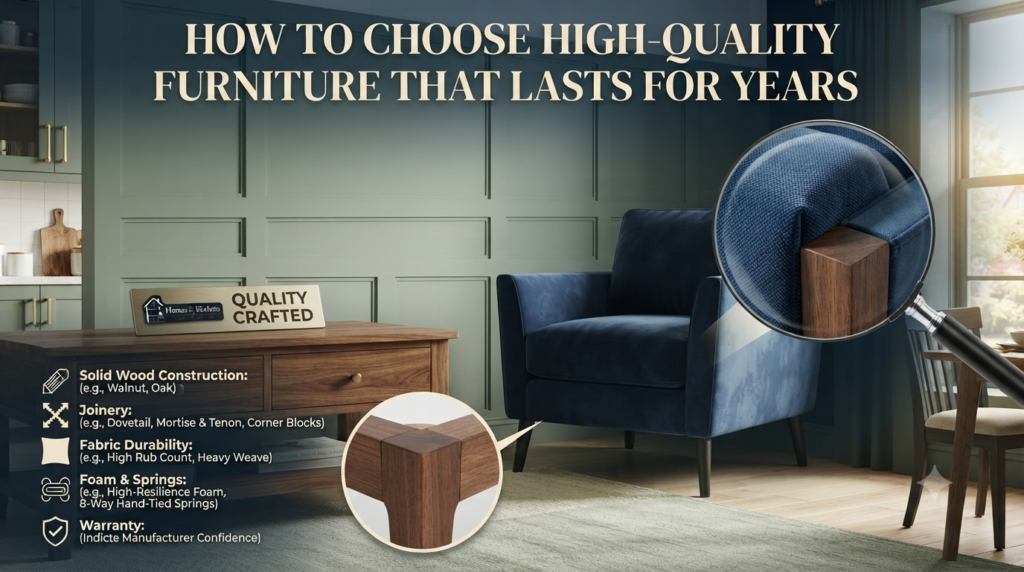
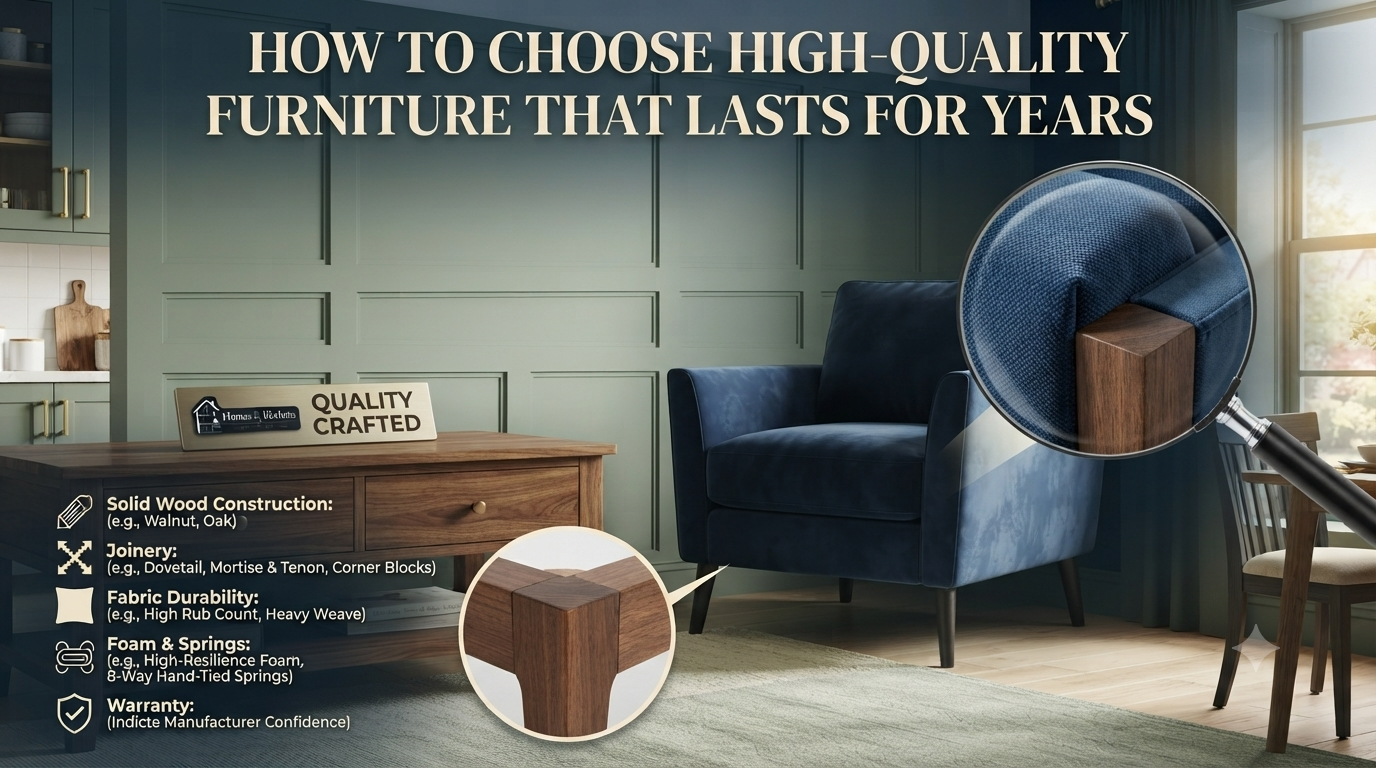
- Kiln-Dried Hardwoods (The Gold Standard): Species such as oak, walnut, maple, cherry, and teak harvested from deciduous trees offer dense cellular structures. Crucially, these lumbers are placed in commercial kilns to reduce moisture content down to an optimal 6 to 8 percent. This prevents the wood from warping, cracking, or splitting as seasonal humidity shifts inside your home.
- Softwoods (Acceptable for Secondary Parts): Pine, fir, and spruce are less dense. While acceptable for interior drawer sides or hidden backing panels, softwoods dent easily and lack the structural rigidity required for primary load-bearing frames.
- Engineered Woods (Use with Caution): Medium-density fiberboard (MDF), particleboard, and cheap plywood consist of wood dust or thin plies glued together under pressure. While high-grade marine plywood has excellent stability for flat panels, low-grade particleboard swells permanently when exposed to moisture and loses its grip on screws over time.
Identifying Superior Joinery Techniques
Glue and steel staples are never enough to hold a high-quality frame together. Examine how the structural corners and connections are assembled:
- Mortise-and-Tenon: One of the oldest and strongest woodworking joints. A protruding tab (the tenon) fits snugly into a precisely carved cavity (the mortise), often locked with a dowel.
- Dovetail Joints: Primarily used in drawer construction. Interlocking wedge-shaped fingers lock together permanently, resisting pull forces when drawers are yanked outward.
- Corner Blocks: In upholstered sofas and chairs, small triangular pieces of wood glued and screwed into the interior frame corners distribute stress and prevent the frame from racking or twisting.
Decoding Upholstery, Cushions, and Suspension Systems
When buying soft seating, the upholstery fabric is often what catches your eye, but the internal suspension and foam density determine whether the piece remains comfortable after five years of daily use.
Cushion Foam Density and Composition
- High-Resiliency (HR) Polyurethane Foam: High-end foam features a high density (typically 2.5 pounds per cubic foot or higher) and rebounds rapidly when compressed. It provides firm, supportive comfort that resists permanent body impressions.
- Low-Density Polyurethane Foam: Cheap foam breaks down quickly under body weight, leading to sagging, lumpy cushions within months.
- Down and Feather Wraps: For ultimate plushness, premium cushions feature an HR foam core wrapped in a channeled baffle bag filled with down feathers or synthetic cluster fibers. This gives a soft initial sit with a supportive interior foundation.
Suspension Systems: What Lies Beneath the Cushions
- Eight-Way Hand-Tied Springs: Found in heirloom-quality sofas. Steel coil springs are tied together by hand using waxed twine in eight distinct directions, allowing weight to disperse evenly across the entire seating platform.
- Sinuous Wire Springs (No-Sag Springs): S-shaped steel wires running from the front frame rail to the back. When manufactured with heavy-gauge steel and properly spaced, sinuous springs offer excellent, durable support at a more accessible price point.
- Webbing: Interwoven elastic and rubber bands. While common in lightweight modern furniture, webbing stretches out and loses tension faster than steel coil systems.
Room-by-Room Guide to Identifying Quality Pieces
Different rooms impose unique mechanical stresses on furniture. Here is how to assess quality across your living spaces.
Living Room Seating and Tables
- The Frame Test: Lift one front corner of a sofa or armchair about six inches off the floor. If the opposite front leg stays on the floor, or if the frame twists and squeaks, the internal joinery is weak.
- Table Stability: Press down firmly on the corners of a coffee table or media console. Quality tables feature bolted leg attachments or reinforced aprons that prevent lateral shaking. For layout inspiration, explore our guide on Kitchen Remodel Cost Guide or interior spatial flows.
Bedroom Storage and Bed Frames
- Dresser Construction: Pull out a bedroom drawer completely. Look for solid wood drawer boxes joined by dovetails rather than stapled particleboard. Inspect the glides: ball-bearing steel side-mount slides offer smoother, more durable motion than plastic center tracks.
- Bed Frame Support: Avoid beds that rely on a single flimsy center slat. Look for solid hardwood center support beams equipped with adjustable steel floor feet to bear the weight of heavy mattresses and sleepers.
Dining Room Tables and Chairs
- Table Top Construction: Check whether a dining table is solid wood or wood veneer over stable core plywood. High-grade veneer over a stable core is actually less prone to seasonal cracking in extreme climates than massive solid slabs, provided the veneer is thick and expertly applied.
- Chair Joint Inspection: Turn a dining chair upside down. Look for corner braces glued and screwed into the leg-to-seat joints. A wobbly dining chair is a sign of inferior corner reinforcement.
Curating Your Home: Recommended Furniture Frameworks
To help guide your investment strategy, consider these structural categories when selecting high-end foundational pieces:
1. Best Overall Upholstery Investment: Custom Hardwood Frame Sofa with Eight-Way Hand-Tied Springs
- Why We Chose It: Combines a kiln-dried maple frame, durable sinuous or hand-tied steel suspension, and high-resiliency foam that can be re-upholstered decades down the road.
- Best For: High-traffic family living rooms and formal sitting areas.
2. Best Budget-Smart Investment: Solid Pine or Rubberwood Dovetail Dresser
- Why We Chose It: Rubberwood and plantation-grown pine offer genuine solid wood construction at a fraction of exotic hardwood prices, provided they feature proper dovetail joinery.
- Best For: Guest bedrooms, children’s rooms, and budget-conscious homeowners wanting real wood.
3. Best Premium Dining Investment: White Oak or Walnut Extendable Trestle Table
- Why We Chose It: Heavy trestle bases allow maximum legroom while solid hardwood construction develops a rich, protective patina through decades of family meals.
- Best For: Dining rooms, open-plan kitchens, and multi-generational homes.
Comprehensive Furniture Quality Comparison Matrix
| Construction Element | Low Quality / Fast Furniture | Medium Quality / Standard Retail | High Quality / Heirloom Grade |
| Primary Frame Material | Particleboard, MDF, stapled soft plywood | Kiln-dried pine or mixed engineered wood | Kiln-dried oak, walnut, maple, or teak |
| Joinery Methods | Staples, hot glue, cam locks | Dowels, corner blocks, screw fastenings | Mortise-and-tenon, dovetail, corner blocking |
| Sofa Suspension | Elastic webbing or thin wire mesh | Heavy gauge sinuous steel wire springs | Eight-way hand-tied steel coil springs |
| Cushion Foam Core | Low-density polyurethane (under 1.8 lbs) | Medium-density foam with Dacron wrap | High-resiliency foam wrapped in down/feather |
| Drawer Glides | Plastic rollers or friction wood tracks | Epoxied steel side-mount tracks | Heavy-duty ball-bearing full-extension slides |
Common Mistakes to Avoid When Buying Durable Furniture
Even well-intentioned buyers often overlook critical structural warning signs. Avoid these common missteps:
- Mistake 1: Judging quality solely by the exterior veneer or finish.
- Correction: A shiny lacquer finish can easily conceal flimsy particleboard frames and weak stapled joints. Always inspect the underside, interior, and weight of the piece.
- Mistake 2: Ignoring weight and density.
- Correction: If a wooden coffee table or dresser feels suspiciously lightweight, it likely contains hollow cores or low-grade particleboard rather than dense structural lumber.
- Mistake 3: Overlooking doorway and hallway measurements.
- Correction: Buying a massive, one-piece custom sofa or solid armoire without measuring entry clearances leads to delivery failure or damaged drywall. Always verify dimensions.
- Mistake 4: Failing to test furniture ergonomics in person.
- Correction: Ordering seating online without reviewing seat depth, back height, and cushion firmness ratings often results in physical discomfort during daily use.
Frequently Asked Questions
How can you tell if furniture is high quality?
High-quality furniture features heavy, dense construction made from kiln-dried hardwoods, reinforced joinery like mortise-and-tenon or dovetails, sturdy steel suspension systems, and high-resiliency cushioning that resists sagging.
What is the best wood for durable furniture?
Hardwoods such as white oak, walnut, hard maple, and teak are considered the best for durable furniture due to their dense cellular structure, impact resistance, and natural structural stability.
Is solid wood furniture always better than engineered wood?
Not always. While solid wood offers unmatched reparability and aging character, high-grade marine plywood or MDF veneered panels are often more dimensionally stable in humid climates, preventing large panels from warping.
How do I know if a sofa frame is well built?
Lift one corner of the sofa off the floor. If the opposite leg lifts simultaneously without twisting or squeaking, the frame is rigid. Additionally, feel beneath the fabric for solid hardwood framing rather than lightweight particleboard.
What is kiln-dried wood and why does it matter?
Kiln-drying places lumber in a controlled oven environment to lower its internal moisture to around 6 to 8 percent. This stops the wood from warping, cracking, or shrinking after it enters your climate-controlled home.
How can I make my upholstered furniture last longer?
Vacuum upholstery weekly with a soft brush attachment to remove abrasive dust particles, keep furniture out of direct sunlight to prevent fabric fading, and rotate or flip cushions monthly to distribute wear evenly.
What are performance fabrics and do I need them?
Performance fabrics (such as Crypton, solution-dyed acrylics, or stain-treated linen blends) are engineered to resist liquid absorption, stains, and abrasion. They are essential for households with pets or children.
How do I check if drawer construction is durable?
Pull the drawer completely out and inspect the corners. Quality drawers feature interlocking dovetail joints secured with wood glue rather than small staples, nails, or hot glue.
How much weight should a quality dining chair support?
A well-constructed solid wood dining chair with reinforced corner blocking should comfortably support at least 250 to 300 pounds of downward and lateral pressure without flexing.
How do I prevent wood furniture from drying out and cracking?
Condition natural wood surfaces annually with a quality beeswax or furniture oil, and use a humidifier during dry winter months to maintain stable indoor humidity levels.
Can high-end furniture be repaired if damaged?
Yes. One of the greatest benefits of investing in solid wood and high-grade upholstered furniture is that solid wood can be sanded and refinished, and sofas with sturdy frames can be completely re-upholstered.
What is the difference between sinuous springs and hand-tied springs?
Sinuous springs are S-shaped steel wires that run horizontally across a frame, offering great support at a lower cost. Hand-tied springs are individual coil springs laced together with twine in eight directions, representing traditional heirloom craftsmanship.
How do I choose furniture for a home with pets?
Select tight-weave performance fabrics (like microfiber or heavy canvas) that cat claws cannot easily snag, avoid loose weaves like chenille, and choose medium wood tones that conceal pet hair effectively.
What should I look for in an office desk frame?
Look for steel-reinforced legs, solid wood or thick veneer tops, and integrated cable management channels that prevent wires from straining joints and connections over time.
How often should furniture hardware be tightened?
Inspect and tighten chair legs, table aprons, and drawer pulls every 6 to 12 months, as normal household vibrations and daily use can cause screw fastenings to loosen gradually.
Conclusion and Final Verdict
Choosing high-quality furniture that lasts for years is an intentional shift away from disposable consumerism and toward mindful home investment. When you evaluate the hidden structural components—insisting on kiln-dried hardwoods, robust joinery like mortise-and-tenon or dovetails, and high-resiliency cushion cores—you protect your financial investment and enhance your daily quality of life. Furniture should be a supportive partner in your household story, aging gracefully through family dinners, quiet reading sessions, and years of comfortable living.
Key Takeaways
- Inspect the skeleton: Always look past surface finishes to verify solid wood framing and kiln-dried lumber.
- Demand superior joinery: Prioritize mortise-and-tenon frames and dovetail drawers over staple-gunned particleboard.
- Test suspension and foam: Choose high-resiliency cushion foam and robust steel spring systems to prevent sagging.
- Maintain your investments: Condition natural wood, vacuum upholstery, and tighten hardware annually to ensure decades of reliable use.
By applying these rigorous material standards and evaluation techniques, you will build a timeless, enduring home environment tailored precisely to your standards of excellence.
Ready to invest in furniture that stands the test of time? Start by auditing your current rooms for structural weak points, measure your spatial clearances carefully, and focus your next furniture investment on foundational solidwood and durable upholstery engineered for decades of real life.