Introduction
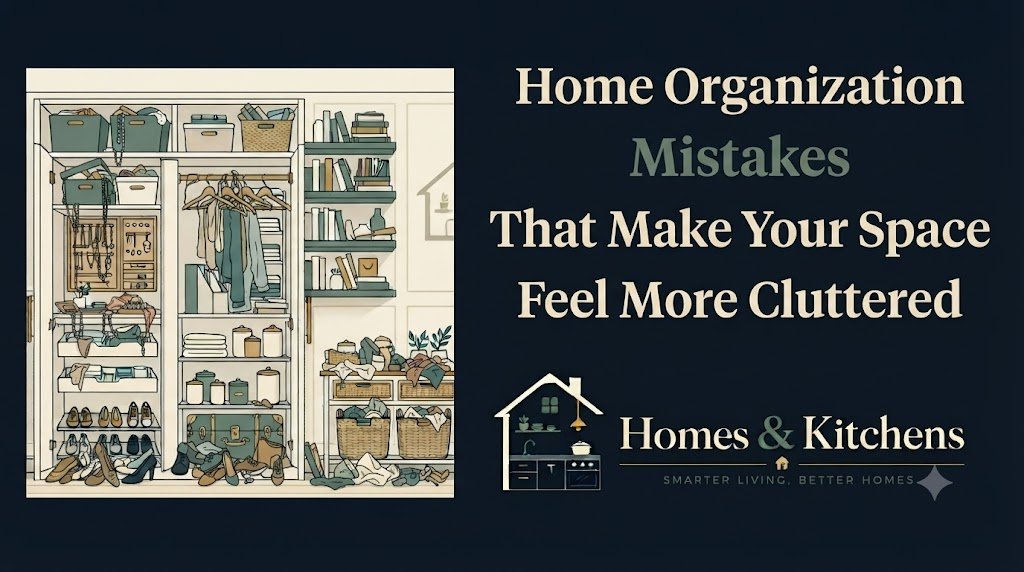
There is a distinct, frustrating moment that many homeowners experience: you spend an entire weekend sorting belongings, purchasing sleek matching bins, labeling shelves, and tucking items away, only to step back and realize the room still feels heavy, chaotic, and unorganized.
When home organization fails to deliver a sense of calm, the culprit is rarely a lack of effort. More often, it stems from common strategic missteps during the organizing process. True organization goes far beyond stuffing items into containers or following fleeting aesthetic trends from social media. At Homes & Kitchens, our knowledge-first philosophy emphasizes that understanding why organizational systems fail is just as important as setting them up. This guide explores the most frequent home organization mistakes that inadvertently make your living space feel more cluttered—and provides the practical steps needed to fix them.
Buying Storage Bins Before Decluttering
One of the most pervasive traps in home organization is the urge to run out and buy decorative baskets, plastic bins, and drawer dividers before you have even touched your belongings.
- The Problem: Purchasing storage products prematurely forces you into reverse engineering. You end up trying to fit your possessions into arbitrary container sizes, often resulting in wasted space, mismatched bins, and surplus items squeezed into containers where they simply do not belong.
- The Fix: Always complete a thorough decluttering audit using a structured sorting framework (such as the four-box keep, donate, trash, and relocate method) before shopping for storage hardware. Once you know the exact volume and dimensions of what is staying, you can buy containers tailored precisely to those items.
Overcomplicating Organizational Systems
It is easy to get swept up in elaborate, highly intricate organizational setups featuring color-coded labels, multi-step sub-categories, and rigid rules.
- The Problem: If an organizational system requires five distinct steps, exact color-matching, and constant maintenance to put away a single pair of socks or a kitchen tool, family members will abandon it within a week. When a system is too complex, clutter returns with a vengeance.
- The Fix: Keep your systems intuitive and frictionless. The best organizational rule of thumb is proximity: store items as close as possible to the exact spot where they are actually used. If putting an item away takes less effort than leaving it out, the system will maintain itself naturally.
Ignoring Visual Static and Open Shelving Overload
Open shelving and glass-front cabinets have enjoyed immense popularity in kitchen and living room design, offering an airy, modern aesthetic. However, they require strict discipline.
- The Problem: Open shelving quickly transforms into visual static—an overwhelming jumble of mismatched colors, logos, and textures that overloads the visual cortex and makes a room feel inherently messy, even when every item is technically in its place.
- The Fix: Reserve open shelving for curated, uniform items (such as stacks of white dishware or neatly aligned glass pantry canisters). Store mismatched, high-utility items behind closed cabinet doors where visual noise is completely concealed.
Failing to Utilize Vertical Space
Many homeowners limit their organizational thinking strictly to floor level and the lower shelves of closets and cabinets.
- The Problem: Leaving walls, the backs of doors, and upper cabinet heights completely empty squanders a massive percentage of your home’s total cubic storage capacity. This forces everyday items to overflow onto countertops and floors.
- The Fix: Look upward. Install floor-to-ceiling floating shelving, mount racks on the inside of pantry and bathroom doors, and utilize double-hanging closet rods to maximize your vertical storage footprint.
Overcrowding and Stacking Items Deeply
When storage space is limited, the temptation is to push items as far back into cabinets and closets as possible, creating deep, multi-row stacks.
- The Problem: Deep, stacked storage creates an out-of-sight, out-of-mind black hole. To retrieve a single frying pan or winter sweater at the back, you have to unstack half your inventory, creating immediate chaos.
- The Fix: Prioritize accessibility over sheer packing density. Use sliding pull-out wire drawers, shelf risers, or vertical dividers so every single item can be seen and reached independently without disturbing surrounding objects.
Part 6: Home Organization Mistakes Comparison Matrix
Review the common organizational errors, their negative visual impacts, and the correct expert solutions below:
| Common Mistake | Why It Fails | Resulting Clutter Impact | Expert Solution |
| Buying Bins First | Forces items into arbitrary container sizes | Mismatched bins & wasted space | Declutter ruthlessly before purchasing storage products |
| Overcomplicating Systems | Requires too many steps to maintain | Abandoned routines & scattered items | Design intuitive, low-friction systems based on proximity |
| Open Shelf Overload | Exposes mismatched colors and shapes | High visual static & mental fatigue | Curate open shelves; hide mismatched items behind closed doors |
| Ignoring Vertical Space | Leaves upper walls and doors empty | Floor and countertop overflow | Install floor-to-ceiling shelving and over-the-door racks |
| Deep Item Stacking | Buries inventory behind front rows | Disorganized avalanches during retrieval | Install pull-out drawers and vertical dividers |
Common Questions About Fixing Disorganized Spaces
1. Why does my house still look cluttered even after I organize?
If your home still looks messy after organizing, you likely have too many physical possessions for your square footage, or your storage solutions are exposing too much visual static (such as overcrowded open shelving and mismatched packaging).
2. Is it bad to use opaque plastic bins for everything?
Opaque bins are fantastic for hiding visual clutter in garages and closets, but they can backfire in high-use zones like pantries and refrigerators where you need instant visual identification to avoid repurchasing duplicate items.
3. How do I stop horizontal surfaces from collecting clutter?
Horizontal surfaces like kitchen counters and entry tables act as natural landing pads. Establish strict micro-zones—such as a designated tray for mail and keys—and practice a 10-minute nightly clearing sweep.
4. How often should I re-evaluate my home organization systems?
Conduct a thorough organizational audit twice a year during seasonal transitions in spring and fall to adapt your storage layouts to changing family routines.
5. What should I do with sentimental items that cause clutter?
Designate one single memory box per family member. If a sentimental item exceeds that physical boundary, take a high-resolution photograph for a digital album before letting the physical object go.
Key Takeaways
- Purge Before You Buy: Never purchase storage containers until you have completely sorted and edited your inventory.
- Keep Systems Simple: Design intuitive, low-friction storage routines that your entire household can easily maintain.
- Conceal Visual Static: Use closed cabinetry for mismatched everyday items, reserving open shelving strictly for curated collections.
- Maximize Vertical Volume: Utilize wall heights and door backs to prevent clutter from overflowing onto floors and countertops.
Final Recommendation
Recognizing and correcting these common organizational mistakes is the fastest way to turn a frustrating, cluttered house into a calm, functional home. Start by auditing one high-impact area—such as a chaotic pantry or an overflowing kitchen counter—and apply the principle of simplicity and vertical efficiency. Once you eliminate visual static and streamline your daily habits, your entire living space will feel noticeably lighter and more organized.
Call to Action
Ready to optimize your entire home? Explore our comprehensive Kitchen Cabinets Guide, review our expert tips on Kitchen Organization Ideas, or discover how to maximize your living quarters with our in-depth design breakdowns.