Introduction
Utility bills rarely move in one direction: down. For most American households, electricity, gas, and water costs consume a significant portion of monthly budgets. When utility statements arrive, heating, cooling, water heating, and large household appliances are usually the primary culprits behind the numbers.
Appliances account for a substantial portion of an average home’s energy consumption. Older refrigerators, worn-out washers, inefficient water heaters, and outdated HVAC systems silently drain electricity and gas around the clock. Upgrading to energy-efficient home appliances is one of the most reliable ways to curb this ongoing drain.
This guide looks beyond marketing hype. We explore the mechanics of appliance efficiency, how to read energy labels, which upgrades offer the fastest return on investment, and how to operate your existing and new appliances for maximum savings. Knowledge comes first. Let us examine how home energy use actually works.
Understanding Home Energy Consumption
Before purchasing new hardware, it helps to understand where energy goes inside a typical house. According to data from the U.S. Department of Energy and the U.S. Energy Information Administration (EIA), space heating and cooling represent the largest share of home energy use, often hovering near 50%.
Water heating follows closely behind, taking up roughly 18% of household energy. Lighting, refrigeration, clothes washers, dryers, and electronic devices make up the remainder.
| End-Use Category | Share of Energy (%) |
| Space Heating & Cooling | ~50% |
| Water Heating | ~18% |
| Lighting & Electronics | ~10% |
| Refrigeration & Kitchen Appliances | ~10% |
| Laundry (Washers & Dryers) | ~6% |
| Other Miscellaneous Uses | ~6% |
The Role of Aging Appliances
An appliance built twenty years ago uses vastly more electricity and water than a modern equivalent. For instance, a refrigerator from the 1990s can consume over 1,000 kilowatt-hours (kWh) per year, whereas a modern ENERGY STAR certified model often uses less than 450 kWh. Over time, mechanical wear, degrading insulation, and outdated motor designs compound inefficiency.
How to Calculate Appliance Running Costs
To determine what an appliance costs to run, use this basic formula:
$$\text{Annual Cost} = \frac{\text{Wattage} \times \text{Hours Used Per Day} \times 365}{1,000} \times \text{Cost per kWh}$$
If your refrigerator draws 150 watts continuously and your electricity rate is 16 cents per kWh:
$$\frac{150 \times 24 \times 365}{1000} = 1,314 \text{ kWh}$$
$$1,314 \times \$0.16 = \$210.24 \text{ per year}$$
By replacing that unit with an efficient model drawing 60 watts, your annual operating cost drops to roughly $84.09, saving over $125 annually on that single appliance.
Decoding Energy Labels: What to Look For
Navigating appliance specifications can feel overwhelming. Manufacturers use various metrics, but two primary labels dictate energy performance in the United States.
The ENERGY STAR Label
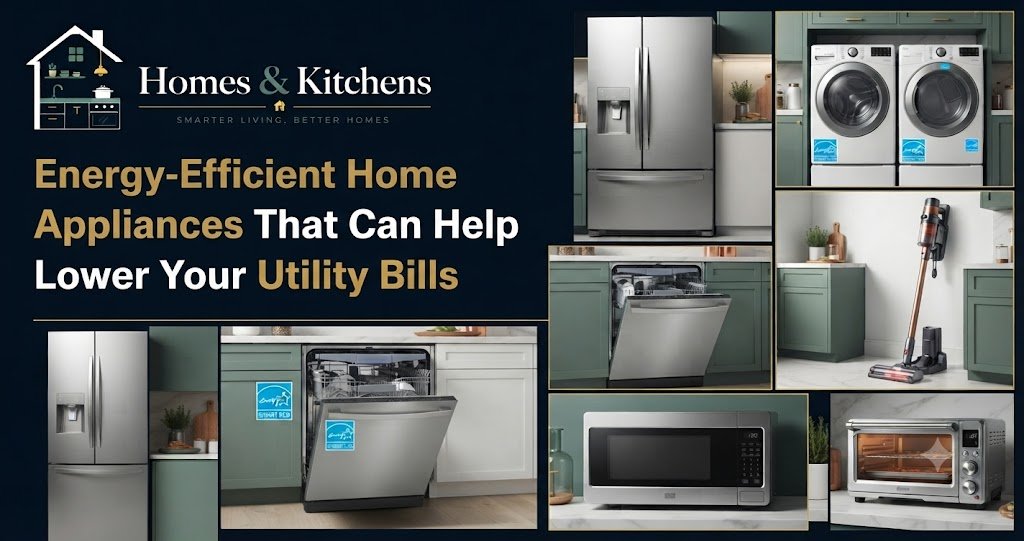
Managed by the U.S. Environmental Protection Agency (EPA) and the Department of Energy, the blue and white ENERGY STAR label identifies products that meet strict energy performance standards without sacrificing features or performance.
- What it means: An ENERGY STAR certified refrigerator uses at least 9% less energy than models that meet federal minimum efficiency standards. Certified clothes washers use about 25% less energy and 33% less water than standard models.
- Why it matters: It provides an instant benchmark. You do not need to parse complex engineering data to know a product is efficient.
The EnergyGuide Label
Mandated by the Federal Trade Commission (FTC), the bright yellow EnergyGuide label appears on nearly all major home appliances. It provides two crucial pieces of data:
- Estimated Annual Energy Consumption: Measured in kWh (for electric appliances) or therms (for gas appliances).
- Cost Comparison Scale: A sliding bar showing how the model’s energy use stacks up against similar models on the market, along with an estimated yearly operating cost based on a national average utility rate.
Expert Tip: The cost estimate on the yellow EnergyGuide label is calculated using a national average electricity rate (often around 14 to 16 cents per kWh). If you live in an area with high electricity rates—such as the Northeast or California—your actual operating costs will be higher than the label estimate. Always recalculate using your local utility rate for accuracy.
Key Energy-Efficient Appliances for Every Room
Let us examine the major household categories, breaking down the mechanics, potential savings, and top recommendations for each.
1. Kitchen Appliances
The kitchen is an energy-intensive zone. Refrigerators run 24/7, dishwashers heat water and air-dry dishes, and cooking appliances consume high bursts of power.
Refrigerators
Modern refrigerators feature variable-speed compressors, high-efficiency insulation panels, and precise digital temperature controls. Instead of cycling fully on and off, modern inverters adjust motor speed continuously to match cooling demands.
- Best Overall:GE Profile PYE22KYNFS Counter-Depth French-Door Refrigerator
- Why we selected it: Balances precise temperature management with an efficient inverter compressor, earning high marks for interior LED lighting layout and door-seal integrity.
- Best Budget:Whirlpool WRF535SWHZ French Door Refrigerator
- Why we selected it: Offers strong ENERGY STAR performance and reliable cooling without unnecessary smart tech inflations.
- Best for Small Kitchens:Bosch 800 Series Counter-Depth B36CT80SNB
- Why we selected it: Exceptional space utilization, dual compressors for independent fridge and freezer humidity control, and low energy draw.
Dishwashers
Energy savings in modern dishwashers come from advanced soil sensors, efficient water-injection nozzles, and alternative drying technologies like condensation drying or automatic door-opening at the end of a cycle, which eliminates energy-hungry heating coils.
- Best Overall:Bosch 800 Series Built-In Dishwasher SHPM78Z55N
- Why we selected it: Utilizes patented CrystalDry technology, turning moisture into heat using natural minerals, keeping energy use exceptionally low.
- Best Value:Whirlpool WDF550SAHZ
- Why we selected it: Reliable sensor cycles that adjust water usage based on load soil levels, keeping utility use minimal.
Cooktops and Ranges
Traditional electric coil cooktops and standard gas burners lose a substantial amount of heat to the surrounding air. Induction cooktops utilize electromagnetic fields to heat cookware directly.
- Efficiency Breakdown: Induction is roughly 85% to 90% efficient at transferring energy to food, compared to roughly 40% for traditional gas and 65% to 70% for standard electric resistance cooktops. Less wasted heat also reduces indoor cooling loads in summer.
- Best Induction Range:Café C2S950P2MS1 Smart Slide-In Induction Range
- Why we selected it: Delivers rapid heating, precise simmer control, and exceptional energy conservation compared to traditional gas ranges.
For more guidance on kitchen planning, check out our Kitchen Remodel Cost Guide and learn how to optimize your workspace with smart Kitchen Organization Ideas.
2. Laundry Room Appliances
Washing clothes and drying them accounts for a massive chunk of domestic energy—primarily because water must be heated, and heavy wet garments require thermal energy to dry.
Clothes Washers
Front-load washers are inherently more energy and water-efficient than top-load agitator models. Front-loaders tumble clothes through a shallow pool of water, lifting and dropping garments rather than twisting them against a central post. This requires significantly less water to wet the clothes, and less hot water means lower water-heating bills. Furthermore, high-speed spin cycles extract more water before laundry reaches the dryer, drastically cutting down dryer run times.
- Best Overall:Electrolux ELFW7637AT Front-Load Washer
- Why we selected it: Features an adaptive dispenser, excellent stain-removal mechanics, and high-speed spin extraction rates that slash subsequent dryer drying times.
- Best for Families:LG WM9000HVA Mega Capacity Smart Washer
- Why we selected it: Massive capacity allows for fewer overall loads per week, conserving water and electricity across large households.
Clothes Dryers
Traditional electric resistance dryers are among the most power-hungry appliances in a home, often drawing 3,000 to 5,000 watts. Heat pump dryers operate differently. Instead of venting heated air outside, they use a closed-loop refrigerant system to dehumidify and recycle heat inside the drum.
- Efficiency Breakdown: Heat pump dryers use up to 50% to 60% less energy than conventional electric dryers. They operate on standard 120-volt or 240-volt circuits and do not require an exterior exhaust vent, making them ideal for apartments and historic homes.
- Best Heat Pump Dryer:Whirlpool WED9BHEC / Miele T1 Classic Series
- Why we selected it: Miele’s honeycomb drum protects fabrics while the heat pump system keeps energy consumption exceptionally low.
3. Climate Control & Water Heating
While large appliances matter, major energy savings are found in how you condition your home and heat your water.
Heat Pump Water Heaters (Hybrid Water Heaters)
Standard electric resistance water heaters keep a tank of water hot 24/7 using electric heating elements. Hybrid heat pump water heaters draw heat from the surrounding ambient air and pump it into the water tank, utilizing electricity only to move heat rather than generate it.
- Savings Impact: They use up to 70% less energy than standard electric water heaters, saving an average household hundreds of dollars per year.
- Best Overall:Rheem Performance Platinum Hybrid Electric Water Heater
- Why we selected it: Exceptional efficiency ratings, user-friendly digital display, and multiple operational modes (Efficiency, Hybrid, Electric, Vacation).
Smart Thermostats
While not an appliance in the traditional sense, a smart thermostat acts as the brain for your HVAC system. Devices like the Nest Learning Thermostat or Ecobee SmartThermostat learn your household schedule, detect when rooms are vacant, and adjust heating and cooling automatically.
- Savings Impact: According to EPA studies, smart thermostats save homeowners roughly 8% to 15% on heating and cooling bills annually.
Comprehensive Comparison Table
To help you compare appliance types at a glance, review the following matrix detailing efficiency mechanisms, typical savings, and ideal users.
| Appliance Category | Standard Technology | Efficient Upgrade | Est. Energy Saving | Best For |
| Refrigerator | Single-compressor top-freezer | Inverter/Dual compressor French door | 15% – 30% | All households |
| Dishwasher | Heated-coil dry | Condensation/ Auto-open door | 20% – 40% | Frequent cooks |
| Clothes Washer | Top-load agitator | Front-load high-efficiency | 25% energy / 33% water | Large families & eco-conscious homes |
| Clothes Dryer | Vented electric resistance | Heat pump dryer | Up to 60% | Tight spaces, condos, low utility bills |
| Water Heater | Standard electric resistance | Hybrid heat pump | Up to 70% | Single-family homes with garage/basement |
Financial Incentives, Rebates, and ROI
Upgrading every appliance in your home all at once requires significant upfront capital. However, federal, state, and utility-level incentives make these upgrades much more affordable.
The Inflation Reduction Act (IRA)
Federal legislation provides substantial tax credits and rebates for energy-efficient home upgrades under programs like HOMES (Home Owner Managing Energy Savings) and HEEHRA (High-Efficiency Electric Home Rebate Act).
- Tax Credits: Under Section 25C, homeowners can claim tax credits for heat pump water heaters, heat pump HVAC systems, and electrical panel upgrades.
- Point-of-Sale Rebates: State energy offices distribute rebates directly at checkout for low-to-moderate-income households buying efficient heat pump appliances and induction ranges.
Local Utility Rebates
Electric and gas utility companies across the country offer cash-back rebates when you purchase ENERGY STAR certified appliances. Always check your local utility provider’s website before buying; rebates often range from $50 for efficient dishwashers to $500+ for heat pump water heaters.
Calculating Return on Investment (ROI)
To find out if an upgrade makes financial sense today, use this equation:
$$\text{Payback Period (Years)} = \frac{\text{Purchase Price} – \text{Rebates}}{\text{Estimated Annual Utility Savings}}$$
If a hybrid water heater costs $1,400, qualifies for a $400 utility rebate and federal tax incentives, and saves you $300 per year in electricity:
$$\text{Net Cost} = \$1,400 – \$400 = \$1,000$$
$$\text{Payback Period} = \frac{\$1,000}{\$300\text{/year}} \approx 3.3 \text{ years}$$
After 3.3 years, the appliance generates pure financial savings for the remainder of its operational lifespan.
Best Practices for Maximizing Appliance Efficiency
Buying an efficient appliance is only half the battle. How you use and maintain it dictates its long-term performance.
1. Eliminate Vampire Power (Standby Consumption)
Many modern appliances—especially those with digital displays, Wi-Fi connectivity, and remote-start capabilities—draw power even when turned “off.” This is known as phantom or standby load.
- Solution: Plug entertainment centers, kitchen coffee makers, and secondary electronics into smart power strips that cut power entirely when devices enter standby mode.
2. Optimize Refrigerator Settings
- Keep refrigerator internal temperatures at 37°F to 38°F and freezers at 0°F. Setting them colder wastes energy without providing food safety benefits.
- Regularly vacuum dust and pet hair from the condenser coils underneath or behind the refrigerator to maintain cooling efficiency.
3. Run Full Loads
- Never run half-empty loads in dishwashers or washing machines. A half-load consumes nearly the same amount of water, heating energy, and mechanical cycles as a full load.
- For laundry, ensure clothes are spun at the highest possible G-force extraction speed your machine allows to reduce dryer run times.
4. Clean Dryer Lint Filters Religiously
- Clean the lint screen before every single load. A clogged lint filter restricts airflow, forcing the dryer to run twice as long and burning out heating components prematurely.
Common Mistakes to Avoid
When shopping for or maintaining energy-efficient appliances, homeowners often stumble into a few common traps:
- Falling for the “Green” Marketing Trap: Not all eco-friendly claims are certified. Look for the official ENERGY STAR logo rather than vague packaging buzzwords like “eco-friendly” or “green.”
- Ignoring Door Seals: A refrigerator or oven with a cracked, brittle gasket leaks conditioned air continuously. Check door seals annually by closing the door on a dollar bill; if it slides out with zero resistance, replace the gasket immediately.
- Buying Oversized Appliances: Bigger is not always better. An oversized refrigerator or washing machine consumes more energy and water than necessary for smaller households, and short-cycles mechanical components.
- Neglecting Vent Maintenance: Failing to clean your dryer’s exterior exhaust duct annually creates a severe fire hazard and forces the motor to overwork, drastically increasing energy draw.
Frequently Asked Questions
1. Are energy-efficient appliances more expensive upfront?
Yes, appliances featuring advanced technologies like variable-speed compressors, heat pumps, or induction coils typically carry a higher initial purchase price. However, their reduced operating costs and available government rebates or tax credits usually offset the price difference over their lifespan.
2. How can I tell if my current appliances are wasting energy?
Check the yellow EnergyGuide label if you still have it, or look up your appliance model online to find its average annual kWh consumption. You can also plug individual appliances into a portable electricity usage monitor (such as a Kill A Watt meter) to measure their exact real-time power draw.
3. Do smart features actually save energy?
Smart features can save energy if utilized correctly—such as scheduling your dishwasher to run late at night during off-peak utility hours or letting your smart thermostat lower heating when you are away. However, if left connected to Wi-Fi without automated scheduling, they add a minimal amount of continuous standby power draw.
4. What is the single most impactful appliance upgrade for lowering bills?
For most homes, upgrading an older electric water heater to a hybrid heat pump water heater yields the fastest and most dramatic reduction in monthly utility bills.
5. How often should major home appliances be replaced?
- Refrigerators: 10 to 15 years
- Dishwashers: 9 to 12 years
- Washing Machines: 10 to 14 years
- Dryers: 10 to 13 years
- Water Heaters (Tank): 10 to 12 years
6. What does “off-peak electricity pricing” mean?
Many utility companies charge different rates depending on the time of day. Peak hours occur when overall grid demand is highest (typically late afternoon and early evening). Running heavy appliances like washers, dryers, and dishwashers during off-peak hours (late evening or early morning) can significantly lower your electricity bill.
7. Do gas appliances count as energy-efficient?
Some high-efficiency gas furnaces and tankless water heaters boast high Annual Fuel Utilization Efficiency (AFUE) ratings. However, national energy policy increasingly encourages electrification (moving from gas to efficient electric heat pumps) to reduce carbon emissions and leverage renewable grid energy.
8. Are ENERGY STAR appliances eligible for tax credits?
Yes. Certain high-efficiency equipment—particularly heat pump water heaters, heat pump HVAC units, and advanced home electrical panels—qualify for federal tax credits under the Inflation Reduction Act.
9. Why does my refrigerator run constantly?
If your refrigerator’s compressor runs non-stop, it may be due to dirty condenser coils, a worn-out door gasket letting cold air escape, blocked airflow vents inside the cabinet, or low refrigerant levels.
10. Does appliance color affect energy efficiency?
No. While aesthetic choices like stainless steel, matte black, or white affect appearance and sometimes fingerprint resistance, they have zero impact on thermal efficiency or electrical power consumption.
Final Verdict
Lowering your utility bills does not require drastic lifestyle sacrifices or uncomfortable living conditions. By replacing aging, power-hungry appliances with high-efficiency alternatives—such as induction cooktops, heat pump dryers, hybrid water heaters, and modern front-load washers—you can drastically curb monthly electricity and gas expenses.
Start by auditing your current energy use, checking local utility rebate programs, and prioritizing upgrades for appliances that run continuously or handle heavy thermal loads. Over time, these thoughtful investments pay for themselves while delivering a more comfortable, reliable home.
Key Takeaways
- Target High-Energy Culprits: Focus your upgrade budget on appliances that use the most energy, such as water heaters, refrigerators, and laundry equipment.
- Look Beyond the Sticker Price: Calculate total cost of ownership by factoring in annual operating costs, utility rebates, and federal tax credits.
- Embrace Advanced Technology: Technologies like heat pumps and induction heating use physics far more efficiently than traditional electric resistance coils.
- Maintain Your Gear: Clean condenser coils, clear dryer lint filters regularly, and check door seals to keep appliances running at peak efficiency throughout their lifespan.
Frequently Asked Questions (Continued)
11. Is it worth repairing an old appliance or buying a new one?
As a general rule of thumb, if an appliance is more than halfway through its expected lifespan and the repair cost exceeds 50% of the price of a new, energy-efficient model, replacement is the more economical choice.
12. How do I find my local utility rebate programs?
You can visit the ENERGY STAR Rebate Finder online tool and enter your ZIP code to view active cash-back offers provided by your local electric, gas, and water utilities.
13. Can renters benefit from energy-efficient appliances?
While renters rarely purchase major appliances like water heaters, they can easily adopt efficient habits, use smart power strips to eliminate standby power, and request energy-saving LED lighting upgrades from landlords.
14. What maintenance tasks protect appliance efficiency?
Routine maintenance includes cleaning refrigerator coils, flushing sediment out of water heater tanks annually, cleaning dryer exhaust vents, and running cleaning cycles on dishwashers and washing machines.
Conclusion
Investing in energy-efficient home appliances is a practical, long-term strategy for financial savings and environmental stewardship. By understanding your home’s energy footprint, interpreting official labels accurately, and adopting smart operating habits, you take control of your utility bills.
Have you recently upgraded to an energy-efficient appliance, or do you have a question about your home’s utility usage? Leave a comment below to share your experience or ask our home improvement experts for advice!