Introduction
Picture this: It is 7:00 AM on a brisk Tuesday morning in Chicago. The radiator is clanking softly, the kitchen is cold, and the only thing standing between you and a functioning workday is a hot cup of coffee. You pad into the kitchen in your slippers, staring down a lineup of brewing gear. Do you flip the switch on the automatic drip machine and walk away? Do you set up the sculptural pour over cone for a clean, ritualistic brew? Or do you grab the heavy glass French press for something rich, bold, and heavy-bodied?
Choosing how to brew your morning coffee is rarely just about caffeine intake; it is a daily design choice. It impacts your counter space, your morning timeline, and most importantly, how your favorite roast tastes in the cup.
Across U.S. kitchens, countertop real estate is precious. Selecting the right brewer means balancing flavor extraction, cleanup time, and convenience. Let’s break down the mechanics, tastes, and realities of French press, pour over, and drip coffee so you can find the exact match for your lifestyle.
Overview of the Contenders
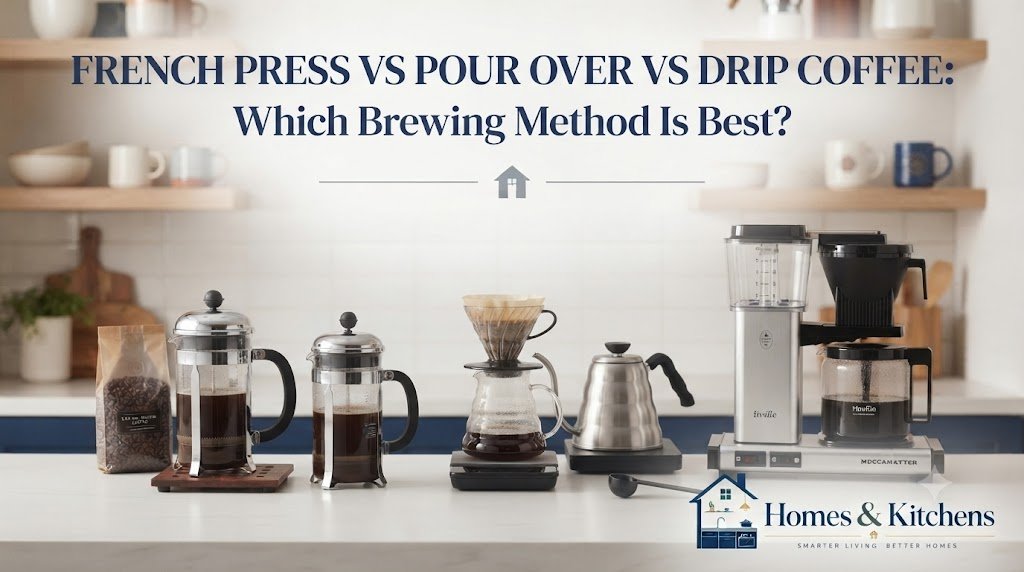
Before diving into the granular details, it helps to understand what makes each of these three brewing pillars unique. They utilize different extraction mechanics, filter types, and water contact times, which dramatically alter the final flavor profile.
- Automatic Drip Coffee: The workhorse of the American kitchen. It automates the heating and water-dispersion process, making it the undisputed champion of set-it-and-forget-it convenience.
- Pour Over: The craft-lover’s favorite. This manual method gives you absolute control over water temperature, flow rate, and saturation, yielding a exceptionally clean and nuanced cup.
- French Press: The immersion champion. By steeping coarse coffee grounds directly in hot water before pressing them through a metal mesh, it preserves natural oils for a thick, velvety body.
Deep Dive: Automatic Drip Coffee
How It Works
An automatic drip machine relies on a simple yet effective thermal system. You pour cold water into a reservoir, where a heating element brings it near boiling. The water travels up an aluminum tube via thermal siphon, drips over a showerhead dispersion screen, and saturates a bed of medium-ground coffee sitting inside a paper or mesh filter. Gravity pulls the liquid through the grounds and down into a carafe, which usually sits on a heated warming plate.
Visual Suggestion
- Diagram: Cross-section graphic of a standard drip coffee maker showing the water reservoir, heating element, siphon tube, showerhead, and filter basket.
Pros and Cons
- Pros:
- High Capacity: Perfect for families, offices, or entertaining, easily brewing 8 to 12 cups at once.
- Effortless Automation: Many modern models feature programmable timers, letting you wake up to a freshly brewed pot.
- Low Learning Curve: Anyone can press a power button.
- Cons:
- Flavor Degradation: Standard glass carafes sitting on hot plates can burn the coffee, turning it bitter after 20 minutes.
- Inconsistent Temperature: Budget drip machines often fail to reach the Specialty Coffee Association (SCA) ideal brewing temperature range of 195°F to 205°F.
- Bulkier Footprint: Takes up permanent, dedicated counter space.
Common Mistakes to Avoid
- Using stale pre-ground coffee: Pre-ground coffee loses its aromatic volatile compounds within days of opening. Invest in a burr grinder and grind just before brewing.
- Neglecting descaling: Mineral buildup from hard tap water clogs internal tubes, reducing water temperature and ruining flow rates. Run a water-and-vinegar cycle every one to three months depending on your local water hardness (refer to guidelines from organizations like the Water Quality Association).
Deep Dive: Pour Over Coffee
How It Works
Pour over brewing is a manual percolation method. You place a cone-shaped dripper (such as a Chemex, Hario V60, or Kalita Wave) over your mug or carafe, line it with a paper filter, and add medium-fine coffee grounds. Using a gooseneck kettle, you manually pour hot water over the grounds in slow, concentric circles. Gravity pulls the water through the bed, filtering out sediments and oils while extracting bright, distinct flavor notes.
Visual Suggestion
- Infographic: Step-by-step pour over technique guide illustrating the “bloom” phase versus the steady spiral pour.
Pros and Cons
- Pros:
- Exceptional Clarity: Paper filters trap bitter oils and micro-grounds, highlighting floral, fruity, or chocolatey origin notes.
- Total Control: You dictate the pouring speed, water temperature, and extraction time.
- Minimal Cleanup: Toss the paper filter and grounds straight into the compost bin.
- Cons:
- Active Time Required: You cannot walk away while brewing; it requires your full attention for three to four minutes.
- Steep Learning Curve: Dialing in the correct grind size and pouring technique takes practice.
- Single-Serve Limitations: Typically designed to make one or two cups at a time, making it tedious for large households.
Expert Tips for Pour Over Success
- Master the Bloom: Always pour just enough water to wet the grounds (about twice the weight of the coffee) and wait 30 to 45 seconds. This releases trapped carbon dioxide, allowing fresh water to extract maximum flavor evenly.
- Invest in a Gooseneck Kettle: A standard kitchen kettle dumps water too fast. A gooseneck spout gives you precise control over water placement and flow velocity.
Deep Dive: French Press Coffee
How It Works
The French press is an immersion brewer. Instead of water passing continuously through coffee grounds, the grounds steep directly in hot water for several minutes inside a cylindrical glass, stainless steel, or ceramic beaker. Once steeping is complete, you push a plunger down. A tight-fitting metal mesh filter forces the grounds to the bottom, separating the rich liquid brew from the spent coffee bed.
Visual Suggestion
- Illustration: Cutaway view of a French press plunger assembly showing the mesh filter separating coarse grounds from the brewed coffee.
Pros and Cons
- Pros:
- Rich, Full Body: Because French presses use metal mesh instead of paper filters, natural coffee oils (diterpenes) pass through into the cup, creating a heavy, luxurious mouthfeel.
- Simple and Durable: No paper filters to buy, no electricity required, and stainless steel models are virtually indestructible.
- Great for Sharing: Easily makes multiple cups at once depending on beaker size.
- Cons:
- Silt in the Cup: The metal mesh lets fine coffee particles (sludge) slip through, leaving a sediment layer at the bottom of your mug.
- Over-Extraction Risk: Coffee keeps steeping as long as it sits with the water below the filter, meaning if you don’t pour it out immediately, the last cup in the press will turn bitter.
- Tedious Cleanup: Scooping wet grounds out of a narrow cylinder can be messy.
Common Mistakes to Avoid
- Using a fine grind: Fine grounds will slip right through the metal mesh, turning your coffee into a muddy brew and clogging the plunger. Always use a coarse, even grind resembling sea salt.
- Leaving coffee in the press: Pour all of the brewed coffee into your mug or a separate thermal carafe immediately after plunging to halt extraction.
Comparison Table
| Feature | Automatic Drip | Pour Over | French Press |
| Brew Time | 5 – 10 minutes | 3 – 4 minutes | 4 – 5 minutes (plus prep) |
| Active Effort | Low (Set & Forget) | High (Manual pouring) | Medium (Steep & Press) |
| Body & Texture | Medium (Clean to moderate body) | Light and clean | Heavy, rich, and oily |
| Capacity | High (4 to 12+ cups) | Low (1 to 2 cups) | Medium (2 to 4 cups) |
| Cleanup | Moderate (Wash basket/carafe) | Very Easy (Toss filter) | Moderate to High (Rinse grounds) |
| Best For | Busy mornings, families, offices | Coffee hobbyists, single-cup drinkers | Dark roast lovers, rich body fans |
Step-by-Step Guides
How to Brew Automatic Drip Coffee
- Fill the Reservoir: Pour fresh, filtered cold water into the machine’s water tank up to your desired cup marker.
- Insert the Filter: Place a paper filter or permanent mesh basket into the brew basket. Rinse paper filters with hot water first to eliminate papery tastes.
- Add Coffee: Measure medium-ground coffee (a general rule of thumb is 2 tablespoons of grounds per 6 ounces of water, or roughly 1:16 coffee-to-water ratio by weight).
- Brew: Close the lid, place the carafe on the warming plate, and press start.
- Serve Promptly: Pour into mugs immediately after the cycle finishes to prevent the heating plate from scorching the brew.
How to Brew Pour Over Coffee
- Heat Water: Bring fresh water to a boil, then let it rest for 30 seconds until it drops to roughly 200°F.
- Prep the Filter: Place your cone dripper over your mug or server, insert the paper filter, and rinse it thoroughly with hot water. Discard the rinse water.
- Add Grounds: Add medium-fine coffee grounds to the filter and gently shake the cone to level the bed.
- The Bloom: Pour twice the weight of your coffee in hot water over the grounds. Wait 45 seconds while the coffee bubbles and expands.
- Extract: Pour the remaining water in slow, steady spiral motions from the center outward, avoiding the paper filter edges. Total brew time should take around 3 to 3.5 minutes.
How to Brew French Press Coffee
- Preheat the Beaker: Pour hot water into your empty French press to warm the glass or steel, then discard the water.
- Add Coarse Grounds: Add coarsely ground coffee to the bottom of the dry press.
- Add Water: Pour hot water (about 200°F) over the grounds, ensuring all coffee is fully saturated. Give it a gentle stir with a wooden or silicone spoon.
- Steep: Place the lid on top with the plunger pulled all the way up. Let it steep undisturbed for 4 minutes.
- Press and Pour: Slowly and steadily push the plunger down. Immediately pour all the brewed coffee into your mug or a thermal server.
Checklist: Choosing Your Ideal Brewing Method
- Morning Schedule: Do I need a machine that brews automatically while I get dressed, or do I enjoy a hands-on morning ritual?
- Serving Size: Am I brewing just for myself, or do I regularly need to supply coffee for a household of three or more?
- Flavor Preference: Do I prefer crisp, bright, tea-like clarity (Pour Over), or a rich, thick, heavy-bodied cup (French Press)?
- Counter Space: Do I have permanent room for a dedicated countertop appliance (Drip), or do I need compact gear that tucks away in a cabinet (Pour Over/French Press)?
- Cleanup Tolerance: Am I willing to rinse out coffee sludge from a metal mesh, or do I prefer tossing a disposable paper filter straight into the trash?
Frequently Asked Questions
Which brewing method extracts the most caffeine?
Immersion methods like the French press typically extract slightly more caffeine per cup because the coffee grounds remain in direct contact with hot water for a longer duration. However, total caffeine content depends heavily on the coffee bean variety (Arabica vs. Robusta) and the total coffee-to-water ratio used.
Why does my drip coffee taste bitter?
Bitterness in drip coffee is usually caused by three factors: over-extraction from water that is too hot, using an overly fine grind size, or leaving the brewed coffee sitting on a hot burner for too long, which cooks the liquid and breaks down its chemical compounds.
Do I really need a special grinder for different brewing methods?
Yes. Burr grinders—which crush coffee beans to a uniform size—are essential. French press requires a coarse grind, pour over needs a medium-fine grind, and drip requires a standard medium grind. Blade grinders chop beans unevenly, resulting in a mix of boulders and fine dust that ruins flavor extraction.
Final Verdict
Choosing the right coffee brewing method comes down to matching your lifestyle with your palate:
- Choose Automatic Drip if convenience, speed, and high-volume capacity rule your morning routine.
- Choose Pour Over if you view coffee as a craft and prize flavor clarity, bright notes, and absolute control.
- Choose French Press if you love a heavy-bodied, rich, robust cup and prefer a hands-on immersion brew without paper filters.
Key Takeaways
- Extraction mechanics matter: Immersion (French press) creates a heavier body, percolation (pour over) delivers clean flavor notes, and automation (drip) offers unmatched convenience.
- Grind size dictates success: Never use a coarse grind for pour over or a fine grind for French press; match your grind size to your extraction style.
- Freshness is king: No matter which method you select, using fresh whole beans and a burr grinder yields a better cup than any high-end machine paired with stale pre-ground coffee.
15. Conclusion
Your morning coffee routine should feel like a reward, not a chore. Whether you lean toward the effortless reliability of an automatic drip machine, the mindful precision of a pour over cone, or the decadent body of a French press, understanding how these systems work empowers you to brew a better cup every single day. Explore more ideas for your morning routine in our Kitchen guides or head back to Homes for more homeowner inspiration.