Introduction
We have all experienced the frustration: you spend hours scrubbing countertops, washing floors, and dusting shelves, only to notice that dust seems to return within twenty-four hours and surfaces feel sticky or dull. Often, the culprit is not a lack of effort, but rather counterproductive techniques passed down through generations or perpetuated by clever marketing.
At Homes & Kitchens, our philosophy is rooted in Knowledge Before Products, Trust Before Commission, and Research Before Opinion. We do not believe in promoting unverified cleaning myths or encouraging endless product purchases. Instead, we examine household maintenance through the lens of microbiology, physics, and surface chemistry.
Whether you are a first-time homeowner, managing a busy family household, or refining your weekend cleaning routine, understanding what not to do is just as important as knowing how to clean. This comprehensive guide breaks down the most frequent cleaning mistakes that inadvertently make your home dirtier, explains the science behind why they fail, and provides actionable protocols to transform your housekeeping.
The Psychology and Chemistry of Ineffective Cleaning
To understand why certain cleaning habits backfire, we must look at how surfaces interact with dust, oils, and chemical residues. Cleaning is not merely a mechanical act of wiping away visible debris; it is a chemical process involving surfactants, friction, and microbiological elimination.
[Improper Chemical Application] → [Surfactant Residue Left Behind] → [Electrostatic Attraction of Dust] → [Faster Re-Soiling]
When you spray a multi-purpose cleaner onto a countertop or floor and wipe it away immediately with an old rag, two unseen failures occur:
- Zero Dwell Time: Chemical disinfectants require physical contact time (dwell time) to puncture bacterial cell walls and deactivate viral envelopes. Wiping them off instantly renders them virtually useless.
- Surfactant Film Accumulation: Many commercial cleaners leave behind soapy surfactant residues. As these microscopic residues dry, they act like a subtle adhesive sheet, capturing airborne dust particles and accelerating surface re-soiling.
Recognizing these invisible dynamics allows us to overhaul our cleaning habits and achieve a genuinely clean, healthy indoor environment.
The Top 10 Cleaning Mistakes That Make Your Home Dirtier
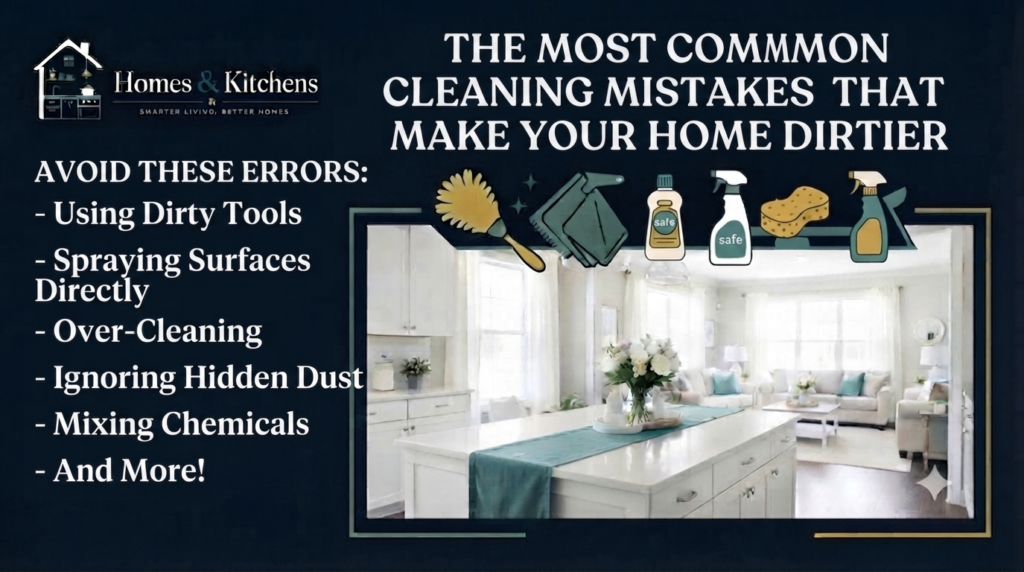
Reviewing our daily routines reveals ten widespread habits that undermine our cleaning efforts.
1. Wiping Disinfectants Away Instantly (Ignoring Dwell Time)
- The Mistake: Spraying a surface with bleach or quaternary ammonium disinfectants and wiping it dry within five seconds.
- Why It Fails: Pathogens require sustained chemical exposure to die. Most commercial disinfectants require a minimum wet dwell time of 3 to 10 minutes to sanitize effectively.
- The Correction: Spray the surface until thoroughly glistening, allow it to remain visibly wet for the manufacturer’s specified dwell time, and then air dry or wipe clean. For further guidance on kitchen sanitization, consult our Kitchen Cabinets Guide.
2. Using the Same Rag or Sponge Throughout the Entire House
- The Mistake: Carrying a single sponge or cloth from the bathroom sink to the kitchen island and down to the living room coffee table.
- Why It Fails: This is the primary driver of cross-contamination. You are literally harvesting microscopic fecal bacteria and mold spores from high-risk zones and spreading them across food preparation surfaces.
- The Correction: Adopt a color-coded microfiber system. Dedicate specific cloth colors to bathrooms, kitchens, and dust-prone living areas. Wash them in hot water after every single use.
3. Washing Microfiber Cloths with Fabric Softener or Dryer Sheets
- The Mistake: Throwing dirty microfiber cleaning cloths into the laundry and adding liquid fabric softener or drying them with dryer sheets.
- Why It Fails: Microfiber relies on millions of microscopic, split synthetic fibers that act like tiny hooks to trap dust and grease. Fabric softeners coat these fibers in a waxy chemical film, permanently clogging their structure and rendering them useless.
- The Correction: Wash microfiber cloths separately in warm water using a small amount of liquid detergent (never powder, which can clog fibers), and tumble dry on low heat without dryer sheets or air dry them.
4. Over-Using All-Purpose Cleaners and Leaving Soap Residue
- The Mistake: Drenching floors, glass, and wood furniture in soapy cleansers without rinsing them away.
- Why It Fails: Soaps and detergents are surfactants. When left unrinsed, they form a sticky, microscopic film that attracts dust, pet dander, and oils, making surfaces look dirtier faster than before you cleaned them.
- The Correction: Use minimal product, and always follow up with a clean water rinse on hard floors and high-touch surfaces. For tips on managing smooth food prep zones, explore our deep dive into Countertop Materials.
5. Dusting with Feather Dusters or Dry Rags
- The Mistake: Using traditional feather dusters or dry cotton rags to swipe dust off bookshelves and electronics.
- Why It Fails: Feather dusters do not capture dust; they simply aerosolize it, sending microscopic particulate matter airborne where it floats around for hours before settling right back onto your furniture and entering your lungs.
- The Correction: Always use a slightly damp microfiber cloth or an electrostatic dusting mitt that traps particulate matter securely within its fiber matrix.
6. Vacuuming with a Dirty or Clogged Filter
- The Mistake: Running your vacuum cleaner week after week without ever washing its foam filters or replacing its HEPA cartridge.
- Why It Fails: A choked filter restricts airflow, cutting suction power in half. More critically, fine dust particles bypass the clogged barrier and get blown directly out of the vacuum exhaust, coating your room in a fine haze of allergens.
- The Correction: Inspect and wash vacuum filters every month, allowing them to dry for 24 hours before reinsertion. For equipment recommendations, review our comprehensive Best Vacuum Cleaners for Every Home: Complete Buying Guide for 2026.
7. Cleaning Glass in Direct Sunlight
- The Mistake: Washing windows and glass tabletops during the middle of the day while bright sunlight streams through.
- Why It Fails: Direct heat causes window cleaner and water to evaporate instantly before you have time to buff it dry, leaving stubborn streaks and chemical haze across the glass.
- The Correction: Clean windows on overcast days or during early morning and evening hours when glass surfaces are cool to the touch.
8. Treating Every Stain with the Same All-Purpose Spray
- The Mistake: Reaching for a generic household cleaner to tackle protein stains, tannin spills, or grease marks.
- Why It Fails: Different chemical bonds require specific antagonists. Using heat or the wrong chemical on protein stains permanently sets them. (For a deep dive into correct stain chemistry, reference our guide on How to Remove Common Household Stains: Expert Cleaning Tips That Actually Work).
- The Correction: Match your cleaning agent to the biochemical category of the stain—enzymes for proteins, acids for tannins, and surfactants for grease.
9. Forgetting to Clean the Tools That Clean Your Home
- The Mistake: Storing a slimy mop bucket, a moldy washing machine drum, or a hair-choked vacuum brushroll away without sanitizing them.
- Why It Fails: Storing dirty tools ensures that your next cleaning session starts by introducing old bacteria, mold spores, and grime right back into your living space.
- The Correction: Rinse and air-dry mop heads after every use, run a monthly sanitizing cycle on your washing machine with vinegar and baking soda, and cut hair out of vacuum brushrolls monthly.
10. Starting from the Bottom Up
- The Mistake: Vacuuming and mopping floors first, and then dusting ceiling fans, crown molding, and tall bookshelves afterward.
- Why It Fails: Gravity dictates that dislodged dust and debris will fall straight down onto whatever surface lies beneath it. Dusting last means your freshly cleaned floors are immediately covered in overhead particulate.
- The Correction: Always clean from top to bottom—start with ceiling fans and high ledges, move to mid-level counters and furniture, and finish with vacuuming and mopping floors.
Essential Cleaning Tools & Recommended Equipment
To avoid common cleaning traps, you need reliable, high-performance tools that streamline maintenance without introducing chemical residues.
1. Best Overall Cleaning Arsenal: Pro-Grade Microfiber System
- Why We Chose It: A color-coded, split-fiber microfiber system eliminates the need for harsh chemical sprays, capturing 99% of bacteria with water alone when used correctly.
- Best For: Everyday dusting, streak-free glass wiping, and general home maintenance.
2. Best Budget Cleaning Staple: White Vinegar & Baking Soda Caddy
- Why We Chose It: Natural mild acidity and mild abrasion handle mineral scale and grease without leaving behind sticky surfactant films.
- Best For: Sinks, faucets, microwaves, and tile grout.
3. Best Premium Tool: Sealed HEPA Upright Vacuum
- Why We Chose It: Prevents fine particulate exhaust during floor care, keeping indoor air pristine.
- Best For: All-home carpet and hard floor maintenance.
Comprehensive Cleaning Error Comparison Matrix
| Cleaning Habit / Error | What People Usually Do | Why It Makes Your Home Dirtier | The Correct Expert Method |
| Disinfecting Surfaces | Spray and wipe immediately | Zero pathogen kill time; bacteria survive | Allow 3–10 minutes of wet dwell time |
| Dusting Furniture | Use feather dusters | Aerosolizes dust into room air | Use damp microfiber or electrostatic mitts |
| Washing Microfiber | Add liquid fabric softener | Clogs split fibers with waxy film | Wash in warm water without softeners |
| Cleaning Floors | Mop with soapy water, no rinse | Leaves sticky soap film that attracts dust | Follow soap with a clean water rinse |
| Cleaning Sequence | Vacuum floors first, dust shelves last | Gravity drops dust onto clean floors | Clean top-to-bottom: ceilings to floors |
| Cloth Management | Use one rag for the whole house | Spreads bathroom bacteria to kitchen | Use color-coded cloths per room zone |
Common Mistakes to Avoid When Organizing Your Cleaning Routine
In addition to physical cleaning errors, organizational missteps can cause burnout and ineffective cleaning cycles:
- Mistake 1: Over-purchasing single-use specialty chemical sprays.
- Correction: Most specialty sprays are marketing variations of basic surfactants or acids. Streamline your caddy to multi-purpose essentials.
- Mistake 2: Cleaning reactively rather than establishing a cadence.
- Correction: Waiting until grime builds up requires harsh chemicals and heavy physical exertion. Small daily maintenance routines prevent heavy buildup.
- Mistake 3: Neglecting high-touch invisible zones.
- Correction: Light switches, door handles, remote controls, and cabinet pulls harbor more bacteria than floors yet are frequently ignored during routine cleaning.
Frequently Asked Questions
What are the most common mistakes people make when cleaning?
The most widespread errors include wiping disinfectants off too quickly before they can work, using dirty rags that cross-contaminate rooms, washing microfiber with fabric softener, and cleaning rooms from the bottom up instead of top to bottom.
Does spraying disinfectant and wiping it immediately work?
No. Chemical disinfectants require specific wet dwell times (usually between 3 and 10 minutes) to puncture bacterial cell walls and deactivate viruses. Wiping them instantly removes the active solution before it can sanitize the surface.
Why does my house look dusty even shortly after I clean it?
If your furniture looks dusty soon after cleaning, you are likely using feather dusters that kick dust into the air, leaving behind unrinsed soap residue that attracts new particulate matter, or running a vacuum with a clogged filter.
Can improper cleaning methods ruin hardwood floors and countertops?
Yes. Using excess water on hardwood floors warps planks, while acidic cleaners like vinegar can permanently etch marble, granite, and natural stone countertops. Always match your cleaning solution to the specific material.
How often should I wash my microfiber cleaning cloths?
Microfiber cloths should be washed after every single cleaning session. Storing a damp, dirty cloth promotes bacterial growth and unpleasant mildew odors.
Why do my glass windows always dry with streaks?
You are likely cleaning your windows while direct sunlight is heating the glass, causing the cleaning solution to evaporate before you can buff it dry. Clean windows on overcast days using a clean microfiber glass cloth.
Is it necessary to rinse multi-purpose cleaner off hard surfaces?
Yes. Most multi-purpose cleaners contain soaps and surfactants. If left unrinsed, they dry into a sticky film that captures airborne dust and pet dander, making surfaces dirty much faster.
How do I properly clean my vacuum cleaner to prevent bad smells?
Empty the dust cup after every use, wash foam filters monthly (ensuring 24 hours of air drying), cut wrapped hair out of the motorized brushroll, and wipe down the interior canister housing with a damp microfiber cloth.
What is cross-contamination in home cleaning?
Cross-contamination occurs when bacteria, mold, or grease from high-risk areas (like bathroom toilets or kitchen raw meat prep zones) are transferred to clean areas via unwashed sponges, rags, or mops.
How can I make my cleaning routine more efficient?
Adopt a top-to-bottom approach, use color-coded microfiber tools, let your cleaning chemicals sit for their required dwell times while you work on other tasks, and maintain a consistent weekly schedule rather than tackling massive marathon cleanings.
Final Verdict & Key Takeaways
Achieving a truly clean, healthy home is not about buying more products or scrubbing harder; it is about refining your technique and respecting the science of cleaning.
Key Takeaways
- Respect dwell times: Let disinfectants stay wet on surfaces long enough to actually kill pathogens.
- Ditch the softeners: Never use fabric softener on microfiber cloths if you want them to trap dust effectively.
- Always rinse surfactants: Remove soapy residues so they don’t form sticky films that attract dust.
- Clean top-to-bottom: Always dust high shelves and ceiling fans before vacuuming floors.
By correcting these common cleaning mistakes, you will protect your indoor air quality, preserve your home surfaces, and make your weekly maintenance far more efficient and effective.
How to Clean Every Room in Your House | The Spruce
Watch this professional walkthrough for additional expert strategies on organizing your whole-house cleaning workflow efficiently.