Introduction
Cabinets are the backbone of any kitchen. They consume up to 40% of the average kitchen remodeling budget, dictate the room’s visual rhythm, and silently manage the daily chaos of cookware, small appliances, and pantry goods. When you step into a newly remodeled kitchen, your eyes gravitate immediately toward the cabinetry.
Yet, beneath the polished finish and modern hardware lies a complex engineering puzzle. Choosing kitchen cabinets is not merely about picking a color or a trendy door profile. It is an investment in structural integrity, spatial geometry, and daily ergonomics. A stunning cabinet facade means little if the box sags under the weight of heavy stoneware within two years, or if the drawer slides jam because of inferior hardware.
Navigating the vast landscape of kitchen cabinets can feel overwhelming. You are faced with a dizzying array of construction acronyms, material choices ranging from solid hardwoods to engineered wood cores, and tier systems from flat-pack stock to fully bespoke creations.
This guide strips away the marketing hype. Drawing on decades of hands-on construction experience and kitchen design expertise, we will walk you through everything you need to know to select, size, and source the ideal kitchen cabinets for your home, your workflow, and your budget.
1. Understanding Kitchen Cabinet Anatomy
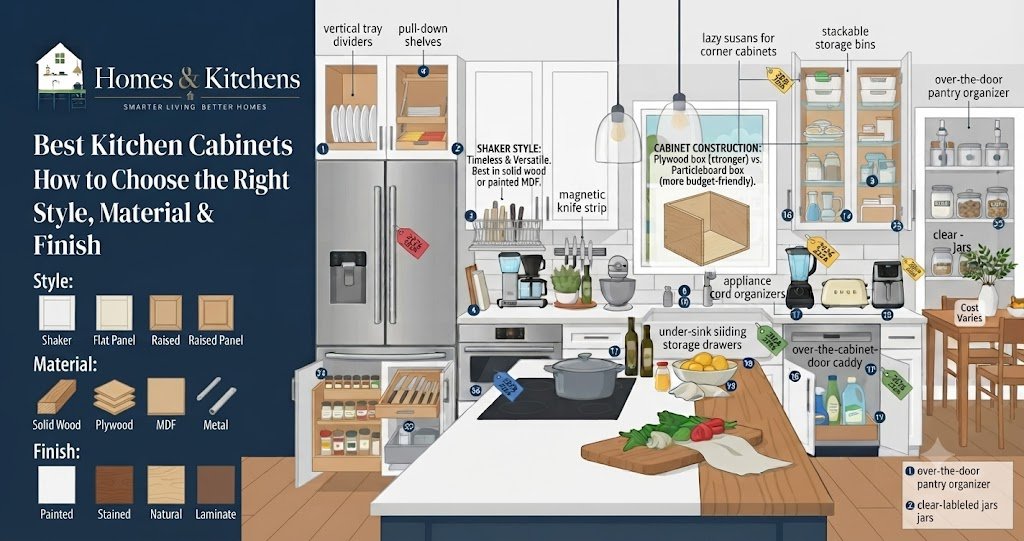
Before evaluating styles or finishes, you must understand how a cabinet is built. A kitchen cabinet is essentially a three-dimensional box composed of two primary components: the box (carcass) and the facade (doors and drawers).
+-------------------------------------------------------+
|                 KITCHEN CABINET ANATOMY               |
+---------------------+---------------------------------+
| Cabinet Box         | Sides, Top, Bottom, Back        |
| Face Frame          | Structural front frame (Framed) |
| Doors & Drawer Fronts| Visual exterior style           |
| Hardware            | Hinges, Slides, Pulls           |
+---------------------+---------------------------------+
The Cabinet Box (Carcass)
The box houses your belongings. It consists of two side panels, a top, a bottom, and a back panel. The quality of the box determines the overall lifespan of your kitchen.
- Materials Matter: High-end cabinets utilize furniture-grade plywood (typically 1/2-inch to 3/4-inch thick) for box construction. Mid-to-low tier cabinets frequently use particleboard or Medium Density Fiberboard (MDF) covered in a melamine or wood-grain paper veneer.
- The Back Panel: Avoid thin, 1/8-inch cardboard-like back panels stapled onto the frame. Look for sturdy 1/4-inch to 1/2-inch solid backs that allow for secure attachment directly to wall studs.
Framed vs. Frameless (European Style) Construction
The debate between framed and frameless construction shapes both the aesthetic and the functional capacity of your kitchen.
- Framed Cabinets (Traditional):
- What it is: Features a 1 1/2-inch solid wood “picture frame” attached to the front of the cabinet box. Doors and drawers mount directly to this frame.
- Pros: Extremely rigid; hides minor out-of-square wall irregularities during installation; timeless aesthetic.
- Cons: The center stile (on double-door cabinets) and frame thickness slightly reduce the clear opening width, making it marginally harder to store oversized platters.
- Frameless Cabinets (Full-Access / European):
- What it is: Eliminates the face frame entirely. The doors attach directly to the sides of the cabinet box using concealed European hinges.
- Pros: Maximizes interior storage space and accessibility; provides a clean, contemporary, seamless look.
- Cons: Requires absolute precision during installation; if walls are severely bowed, fitting frameless boxes flush requires extra shimming.
2. Cabinet Tiers: Stock vs. Semi-Custom vs. Custom
Budget and timeline dictate which tier of cabinetry you select. Each category serves a distinct purpose in home remodeling.
+-------------------+--------------------+--------------------+
| Tier              | Price Point        | Lead Time          |
+-------------------+--------------------+--------------------+
| Stock             | $ (Budget-Friendly)| Immediate / Days   |
| Semi-Custom       | $$ (Mid-Range)     | 3 to 6 Weeks       |
| Custom            | $$$$ (Luxury)      | 8 to 16 Weeks      |
+-------------------+--------------------+--------------------+
Stock Cabinets
Manufactured in mass quantities in standard sizes (typically in 3-inch increments, from 9 inches to 36 inches wide).
- Best For: Tight budgets, rental properties, standard kitchen layouts, and rapid DIY renovations.
- Limitations: Limited finish choices, door styles, and sizing increments. Filler strips are often required to bridge gaps between cabinets and walls.
Semi-Custom Cabinets
The sweet spot for most American homeowners. These are stock cabinets manufactured with customizable options. You can alter depths, heights, and widths in fractional increments or select from a broader catalog of specialty inserts, finishes, and door styles.
- Best For: Most standard residential kitchen remodels balancing cost, personalization, and spatial fit.
- Limitations: Higher cost than stock; modifications are restricted to the manufacturer’s engineering catalog.
Custom Cabinets
Handcrafted specifically for your kitchen by local cabinet makers or high-end architectural millwork shops. Every millimeter is designed around your exact wall dimensions and storage fantasies.
- Best For: Historic homes with uneven walls, luxury architectural builds, highly unique layouts, and homeowners demanding exotic woods and bespoke carvings.
- Limitations: Significant financial investment; long lead times (frequently 3 months or more).
3. Choosing the Right Door Style
Your cabinet doors define the architectural style of your kitchen. When browsing styles, consider whether your home leans traditional, transitional, or contemporary.
Shaker Style
- Design: A five-piece door with a recessed center panel and flat-rail frame.
- Why it works: It is the chameleon of cabinetry. Shaker doors fit comfortably in modern farmhouses, transitional suburban homes, and clean contemporary spaces.
- Maintenance: Extremely easy to wipe down; minimal dust traps compared to heavily profiled traditional doors.
Raised Panel
- Design: A traditional style where the center panel is raised above the surrounding frame, often featuring decorative bevels, profiles, or bead detail.
- Why it works: Brings formal elegance and traditional warmth to large, classic kitchens.
- Maintenance: The profile creases collect kitchen grease and dust more quickly, requiring more frequent dusting.
Flat Panel (Slab)
- Design: A completely smooth, unadorned single slab of wood, MDF, or veneer.
- Why it works: The definitive choice for mid-century modern, Scandinavian, industrial, and ultra-contemporary minimalist kitchens.
- Maintenance: Effortless to clean, though high-gloss flat panels readily show fingerprints.
Inset
- Design: The door and drawer fronts sit flush inside the cabinet face frame rather than overlaying it. Requires meticulous craftsmanship so gaps remain uniform across seasonal humidity changes.
- Why it works: High-end, furniture-like appearance that exudes custom craftsmanship.
4. Materials: What Lies Beneath the Surface
Never judge a cabinet solely by its door. The longevity of your kitchen depends on the materials used for the box, face frames, and internal components.
+-------------------------+------------------------------------------+---------------------------------+
| Material                | Best Used For                            | Durability Rating               |
+-------------------------+------------------------------------------+---------------------------------+
| Hardwood (Maple/Oak)    | Doors, Face Frames, Premium Boxes        | Excellent                       |
| Plywood (Furniture Grade| Cabinet Boxes, Side Panels               | Very Good                       |
| MDF / HDF               | Painted Slab Doors, Stable Center Panels | Good (Susceptible to Water)     |
| Particleboard           | Budget Box Cores                         | Fair                            |
+-------------------------+------------------------------------------+---------------------------------+
Hardwoods vs. Engineered Woods
- Hardwoods (Maple, Oak, Cherry, Birch, Walnut): Natural wood expands and contracts with seasonal humidity shifts. Maple is the gold standard for painted finishes due to its tight, smooth grain. Oak offers classic texture and extreme toughness.
- MDF (Medium Density Fiberboard): Stable and completely warp-resistant. Because it lacks a directional grain, MDF is the premier material for painted cabinet doors—it will not crack at the joints the way solid wood rails and stiles often do.
- Plywood: Layers of wood veneer cross-laminated and glued together. High-grade furniture plywood holds screws tighter than particleboard and resists sagging under heavy loads.
5. Finishes and Paints: Durability Meets Design
The finish protects your cabinet material from moisture, grease, UV degradation, and daily physical impact.
- Painted Finishes: Provide crisp color customization (whites, grays, muted greens, and navy blues). Look for factory-applied UV-cured conversion varnishes or catalyzed polyurethane rather than standard latex paint brushed on-site. Factory finishes are baked on under controlled conditions, offering superior scratch resistance.
- Stained Finishes: Penetrate the wood pores to highlight natural grain patterns (such as quarter-sawn white oak or walnut). Stains hide minor dust and scratches better than solid opaque paints.
- Thermofoil: A vinyl film applied under heat and pressure over an MDF core. It creates a seamless, budget-friendly, highly moisture-resistant white surface. However, avoid placing thermofoil cabinets directly adjacent to high-heat sources like toaster ovens or unshielded oven ranges, as the vinyl can delaminate over time.
6. Hardware & Ergonomics: The Unsung Heroes
You touch your cabinet hardware multiple times a day. Upgrading the internal mechanical components is where you notice the difference between builder-grade frustration and luxury ease.
- Drawer Construction: Demand dovetail joinery for drawer boxes. Interlocking wooden fingers glued together provide lifelong structural strength, vastly outperforming stapled or glued butt joints.
- Drawer Slides: Insist on undermount, full-extension, soft-close drawer slides. Undermount slides hide beneath the drawer box for a clean look, full-extension allows you to see items tucked in the very back, and soft-close dampeners eliminate slamming.
- Hinges: Look for six-way adjustable concealed steel hinges with integrated soft-close technology. They allow you to tweak door alignments easily if your home settles over the years.
7. Product Recommendations & Category Breakdown
To help you navigate the vast array of cabinet options available on the US market, we have curated selections based on real-world testing criteria, build quality, structural warranty, and customer satisfaction.
Best Overall: CliqStudios Signature Series (Semi-Custom)
- Why it was selected: CliqStudios bridges the gap between factory direct pricing and custom design flexibility. Their Signature line utilizes all-plywood box construction, solid maple face frames, and standard soft-close dovetail drawers without requiring luxury custom pricing.
- Best For: Homeowners undertaking a complete kitchen overhaul who want semi-custom sizing and professional design support.
- Key Specs: 1/2-inch plywood sides, 3/4-inch solid hardwood shelves, undermount soft-close glides.
Best Budget: IKEA SEKTION System (Frameless Modular)
- Why it was selected: IKEA’s SEKTION rail-and-bracket mounting system revolutionized DIY kitchen remodeling. The frameless particleboard boxes utilize high-durability melamine foils, and their hardware (manufactured by Blum) carries a generous 25-year limited warranty.
- Best For: DIYers, budget-conscious renovators, and apartment or condo owners maximizing tight footprints.
- Key Specs: Frameless European construction, suspension rail installation, extensive interior organizer ecosystem.
Best Premium / Custom: Plain & Fancy Custom Cabinetry
- Why it was selected: For those seeking heirloom-quality craftsmanship, Plain & Fancy delivers bespoke inset and overlay cabinetry built in Pennsylvania. Their finish room is industry-leading, capable of matching any custom paint swatch with immaculate durability.
- Best For: Luxury homes, historic restorations, and discerning clients seeking total design freedom.
- Key Specs: Solid hardwood construction, custom inset doors, hand-rubbed finishes, lifetime structural warranty.
Best for Families: KraftMaid Vantage Series
- Why it was selected: Families put kitchens through rigorous daily stress. KraftMaid’s Vantage line features robust catalyzed conversion finishes that resist staining from juice spills, sticky fingerprints, and aggressive daily wiping. Their multi-layered topcoats stand up exceptionally well to high-traffic environments.
- Best For: Households with children and pets seeking high durability and smart organizational inserts.
- Key Specs: Solid wood construction options, Whisper Touch hinges and glides, extensive child-safe pullout accessories.
Best for Small Kitchens / Apartments: Cabinets To Go (Stock & Quick-Ship lines)
- Why it was selected: For compact galley kitchens or studio apartments where lead times are tight and spatial efficiency is paramount, their modular stock lines ship quickly and offer narrow width increments down to 9 inches.
- Best For: Investment properties, small urban apartments, and rapid turnarounds.
- Key Specs: Ready-to-assemble (RTA) or assembled options, dovetail drawers, fast shipping logistics.
8. Master Comparison Table
| Brand / Series | Construction Type | Box Material | Door Styles Available | Warranty | Price Tier | Best For |
| CliqStudios Signature | Framed & Frameless | Plywood | Shaker, Raised, Slab | Limited Lifetime | Mid-Range ($$) | Complete Remodels |
| IKEA SEKTION | Frameless (Modular) | Particleboard / Melamine | Shaker, Slab, Glass | 25 Years | Budget ($) | DIYers & Small Spaces |
| KraftMaid Vantage | Framed | Plywood / Hardwood | Comprehensive Catalog | Limited Lifetime | Upper Mid ($$–$$$) | Families & High Traffic |
| Plain & Fancy | Inset / Custom | Premium Hardwood | Fully Bespoke | Lifetime | Luxury ($$$$) | High-End Custom Builds |
| Cabinets To Go | Framed (RTA / Assembled) | Plywood / HDF | Shaker, Traditional | 5 to 10 Years | Budget / Value ($) | Quick-Ship Projects |
9. Comprehensive Buying Guide: Step-by-Step Selection
Choosing your cabinets should follow a logical sequence. Do not fall in love with a door color before confirming your spatial layout and structural needs.
Step 1: Establish Your Realistic Budget
Allocate roughly 35% to 40% of your total kitchen remodel budget to cabinetry. If your total project budget is $30,000, target around $10,500 to $12,000 for the cabinets themselves, leaving room for installation, countertops, and hardware.
Step 2: Map Your Kitchen Workflow (The Work Triangle)
Evaluate your kitchen layout—whether it is a L-shape, U-shape, galley, or perimeter with an island. Ensure your cabinet configuration accommodates the classic work triangle (the spatial relationship between your sink, refrigerator, and range) without bottlenecking traffic.
Step 3: Audit Your Storage Needs
Take inventory of what you own. Do you have an excess of heavy cast-iron skillets that demand deep pot-and-pan drawers? Do you need a dedicated pantry pull-out unit for dry goods? Prioritize drawers over lower cabinet doors; deep lower drawers drastically reduce bending and reaching into dark corners.
Step 4: Select Your Box and Door Specifications
Decide between framed and frameless based on your aesthetic preference. Choose plywood box construction if you live in a humid climate or plan to store heavy dishware, as plywood resists moisture warping better than standard particleboard.
10. Installation & Professional Help: DIY vs. Contractor
Installing kitchen cabinets is not a beginner carpentry task. While assembling an RTA (Ready-to-Assemble) box is straightforward, hanging wall cabinets level, plumb, and square on wavy drywall requires specialized skill.
- When to DIY: If you have intermediate woodworking skills, a laser level, heavy-duty wall anchors, and an extra set of hands to hold heavy boxes in place while securing them to studs.
- When to Hire a Professional: If your walls are severely out of plumb, your floors slope, you are installing heavy custom inset cabinets, or your layout involves complex corner blind units and crown molding carpentry. A professional installer ensures your countertops sit flat and your doors swing without binding.
11. Maintenance & Care Advice
Proper maintenance preserves the factory finish and mechanical integrity of your investment for decades.
- Cleaning Routine: Wipe cabinets down weekly using a soft microfiber cloth dampened with warm water and a drop of mild, pH-balanced dish soap. Never use abrasive scouring pads, steel wool, or harsh chemical bleach, which can strip conversion varnishes.
- Moisture Control: Immediately wipe away steam condensation near the dishwasher and sink base cabinets. Prolonged exposure to standing water causes engineered wood cores to swell and laminate edges to peel.
- Hardware Adjustments: Once a year, check the hinge screws on high-use doors. Tighten any loose screws and use the adjustment screws on European hinges to realign doors that settle.
12. Common Mistakes to Avoid
Remodeling mishaps are expensive. Sidestep these frequent pitfalls during your cabinet selection process:
- Mistake 1: Forgetting Filler Strips Near Walls. Cabinets installed directly against a side wall will prevent doors and drawers from opening fully if filler strips aren’t used to clear corner door trim.
- Mistake 2: Prioritizing Aesthetics Over Ergonomics. Installing rows of narrow upper cabinets instead of wide, accessible lower drawer stacks makes daily loading and unloading an ergonomic chore.
- Mistake 3: Neglecting Appliance Clearances. Ensure your refrigerator door or oven handle doesn’t collide with an adjacent cabinet pull when fully opened.
- Mistake 4: Skipping the Sample Phase. Never order an entire kitchen based on a tiny 2-inch wood chip sample. Order a full sample door in your chosen finish and view it in your kitchen’s natural morning and evening lighting.
13. Frequently Asked Questions
What are the best quality kitchen cabinets?
The highest quality cabinets feature all-plywood or solid hardwood box construction, solid maple or oak face frames, 3/4-inch adjustable shelving, dovetail drawer boxes, and under-mount soft-close glides with factory-baked conversion varnish finishes.
Which cabinet material is most durable?
Hardwoods like maple and white oak combined with furniture-grade plywood boxes offer the highest durability and structural load capacity. For painted finishes, High-Density Fiberboard (HDF) door panels are the most durable because they do not expand, contract, or crack at the joints like solid wood.
Are frameless cabinets better than framed?
Neither is objectively “better”—they serve different design aesthetics and functional needs. Frameless (European) cabinets maximize interior storage capacity and offer a sleek, modern look. Framed cabinets provide traditional charm, greater structural rigidity at the face, and easier installation on uneven walls.
How much should I spend on kitchen cabinets?
As a general rule in home remodeling, kitchen cabinets account for roughly 35% to 40% of your total kitchen renovation budget. In monetary terms, a standard mid-range kitchen cabinet package ranges from $8,000 to $20,000 depending on kitchen square footage and customization.
What is the difference between stock, semi-custom, and custom cabinets?
Stock cabinets are pre-made in fixed sizes and shipped immediately at lower costs. Semi-custom cabinets are stock boxes manufactured with customizable dimensional and aesthetic options (such as color, depth, and organization inserts). Custom cabinets are built from scratch to your exact measurements, offering unlimited design flexibility at a premium price.
Do I need plywood or particleboard cabinet boxes?
Plywood is superior for moisture resistance, screw-holding power, and long-term durability, especially for heavy dishware or humid environments. High-quality industrial particleboard is structurally adequate for dry environments and tighter budgets, provided it is sealed properly against moisture leaks.
What is an RTA cabinet?
RTA stands for Ready-to-Assemble. These are flat-packed cabinets shipped directly to your home for you or your contractor to assemble and install. RTA cabinets offer significant cost savings over pre-assembled factory cabinets.
How do I clean grease off kitchen cabinets?
Mix equal parts white vinegar and warm water with a drop of dish soap. Apply with a soft microfiber cloth, let sit for 30 seconds to break down grease oils, and wipe clean with a separate damp rinsing cloth. Dry immediately with a clean towel.
Are soft-close drawers worth it?
Yes. Soft-close mechanisms prevent cabinet doors and drawers from slamming, protecting the structural joints of the box, reducing household noise, and extending the operational lifespan of your hardware.
How long do good kitchen cabinets last?
High-quality kitchen cabinets constructed with solid wood, plywood cores, and durable factory finishes last anywhere from 25 to 50 years with proper maintenance and gentle use.
Can you paint thermofoil cabinets?
Painting thermofoil is notoriously difficult because standard primers and paints struggle to adhere to the smooth vinyl surface. It requires stripping the peeling vinyl, applying a specialized bonding primer, and spraying an enamel topcoat. Usually, replacing thermofoil doors is more cost-effective.
What is the most popular kitchen cabinet color?
Crisp white and off-white remain the most enduringly popular choices for kitchen cabinets because they reflect natural light and make small spaces feel expansive. However, earthy tones such as warm taupe, muted sage green, and rich navy blue have surged in popularity for transitional and modern designs.
14. Final Verdict
Selecting the right kitchen cabinets requires balancing structural integrity, aesthetic vision, and financial reality. If you prioritize long-term durability and custom sizing, invest in semi-custom, all-plywood cabinets with dovetail drawers and factory-baked finishes. If you are working within a strict budget or managing a rental property, modular frameless stock systems offer incredible utility without sacrificing clean design. Take your time measuring, order full-size door samples, and build a kitchen that serves your household reliably for decades to come.
Key Takeaways
- Structure First: The longevity of your kitchen relies on box materials like furniture-grade plywood and durable joining methods like dovetail drawers.
- Layout Dictates Style: Match your cabinet construction (framed vs. frameless) and door style (Shaker, slab, inset) to your home’s overall architectural character.
- Budget Wisely: Allocate roughly 35% to 40% of your total kitchen renovation budget toward cabinetry and professional hardware.
- Prioritize Drawers: Incorporate deep lower pot-and-pan drawers rather than traditional lower doors to maximize ergonomic accessibility.
Conclusion
Investing in the right kitchen cabinets transforms the heart of your home into a functional, beautiful workspace. By understanding the mechanics of box construction, material differences, and finish durability, you can navigate showroom options with absolute confidence and avoid costly remodeling mistakes.