Introduction
Picture this: It is 7:00 AM on a crisp Tuesday morning in your kitchen. The sun is just starting to peek through the blinds, casting a warm glow across your countertops. You flip on your kettle, ready to transform your favorite single-origin beans into liquid gold. You scoop the beans into your grinder, hit the power button, and wait for that familiar aromatic cloud to fill the room.
Except, when you brew your cup, it tastes aggressively bitter, watery, and harsh. You check your water temperature, your brewing ratio, and even your water filtration system, only to realize the culprit has been hiding in plain sight all along: your grind consistency.
In many U.S. homes, upgrading from pre-ground coffee to whole-bean brewing is the first step toward coffee enlightenment. However, buying your first coffee grinder often leads down a rabbit hole of technical terms, burr materials, and wildly varying price tags. During testing and evaluation of dozens of kitchen setups across the country, one practical lesson homeowners often discover is that a great coffee maker cannot rescue a terrible grind. Whether you are brewing a quick Monday-morning drip pot or dialing in a weekend espresso shot, understanding the mechanical differences between burr and blade grinders is the single most important choice you will make for your morning routine.
Understanding Coffee Extraction
Before looking at specific hardware, it helps to understand why particle size matters. Coffee brewing is fundamentally an extraction process. Hot water strips soluble compounds, oils, and flavors out of the coffee bean.
If your coffee grounds vary wildly in size—some powdery dust, some massive chunks—your extraction will be wildly uneven. The fine particles will over-extract instantly, releasing harsh, bitter tannins. Meanwhile, the large boulders will under-extract, leaving behind all the sweet, fruity, and complex notes you paid good money for.
A quality grinder ensures particle uniformity, allowing water to extract flavor evenly from every single grain. To explore more ways to optimize your culinary workspace, browse our complete Kitchen archives or head back to Homes for more home inspiration.
The Contenders: Blade Grinders Explained
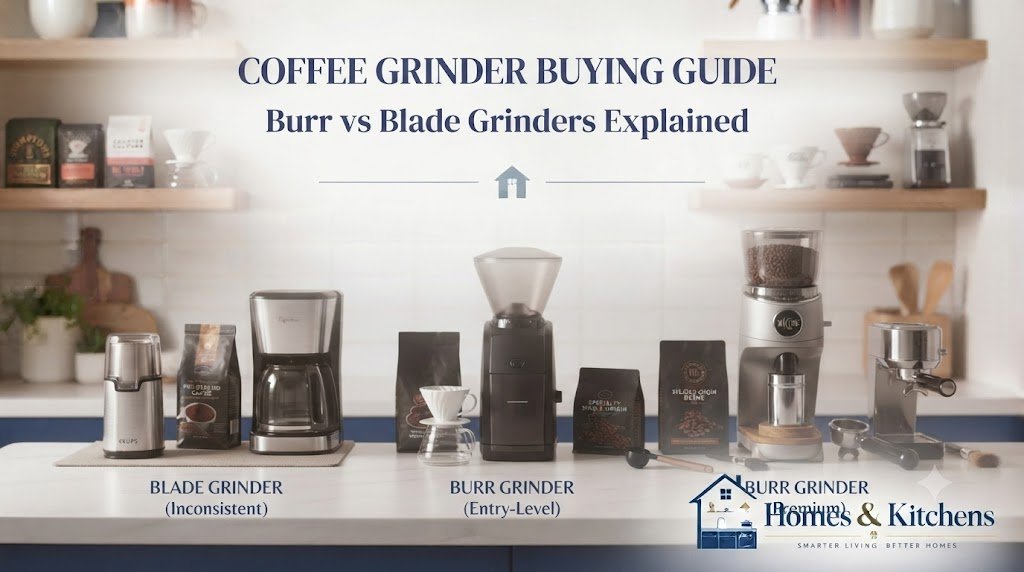
Blade grinders are the most common entry-level devices on the market. If you grew up with a small kitchen appliance that looked like a miniature food processor or a spice mill, you have used a blade grinder.
How Blade Grinders Work
A blade grinder features a dual-pronged metal blade spinning at high speeds—often tens of thousands of RPMs—mounted in the center of a small chamber. It operates much like a household blender. You drop your beans in, press a lid down, and the blades smash and chop the beans into smaller and smaller pieces until you release the button.
Pros of Blade Grinders
- Affordability: They are remarkably inexpensive, frequently costing under twenty-five dollars.
- Speed: They pulverize beans in seconds.
- Versatility: They can double as spice or seed grinders in a pinch.
- Compact Footprint: They take up virtually zero counter space.
Cons of Blade Grinders
- Zero Consistency: You get a chaotic mix of fine dust (often called “bines”) and huge boulders.
- Heat Generation: High-speed spinning blades create friction and heat, which can prematurely cook and degrade delicate coffee aromatics before the beans even touch water.
- No Control: You cannot dial in precise particle sizes for specific brewing methods like pour-over, French press, or espresso.
The Contenders: Burr Grinders Explained
Burr grinders are the gold standard for home baristas and specialty coffee enthusiasts. Instead of chopping beans, burr grinders crush them between two revolving abrasive surfaces called burrs.
How Burr Grinders Work
Coffee beans are fed between a stationary burr and a rotating burr. The distance between these two burrs is adjustable down to the millimeter. As the beans pass through, they are sheared into uniform particles.
Burr grinders generally fall into two categories:
- Flat Burrs: Feature two horizontal, matching ring-shaped burrs facing each other. They tend to produce a very uniform particle distribution and highlight bright, clean flavor notes. They are common in high-end consumer and commercial settings.
- Conical Burrs: Feature a cone-shaped inner burr nested inside a matching outer ring. They operate at lower RPMs, generate less heat, and are exceptionally popular for home use due to their reliability and efficiency.
Pros of Burr Grinders
- Exceptional Uniformity: Every particle is uniform, leading to clean, balanced extraction and sweet flavor profiles.
- Precise Calibration: Easily adjustable settings allow you to dial in everything from Turkish coffee to coarse cold brew.
- Low Heat Output: Lower operating speeds protect volatile aromatic oils.
- Durability: Built to last for years with proper maintenance.
Cons of Burr Grinders
- Higher Price Point: Quality electric burr models require a more significant upfront investment.
- Counter Space and Weight: They are generally larger, heavier appliances than simple blade grinders.
- Retention: Some grounds can get trapped in the chute, requiring periodic cleaning.
Burr vs Blade Comparison
| Feature | Blade Grinder | Burr Grinder |
| Grind Consistency | Highly inconsistent; mix of dust and chunks | Uniform, precise particle size |
| Heat Generation | High (can scorch beans via friction) | Low (preserves delicate flavor profiles) |
| Price Range | Budget-friendly ($15 – $30) | Moderate to High ($40 – $300+) |
| Brewing Flexibility | Poor; difficult to brew anything beyond basic drip | Excellent; handles espresso, pour-over, and French press |
| Durability | Lower; motor and blades wear down faster | Higher; built with hardened steel or ceramic burrs |
Manual vs. Electric Burr Grinders
When shopping for a burr grinder, you will also need to decide between manual hand-crank models and electric plug-in units.
Manual Hand Grinders
Manual grinders use a hand crank attached to a shaft connected to conical burrs.
- Who it is for: Travelers, single-cup enthusiasts, campers, and budget-conscious buyers who want burr-quality grinds without spending hundreds of dollars.
- The Experience: Grinding 20 grams of coffee takes about 45 to 60 seconds of physical effort. Many users find this tactile ritual calming, while others view it as a chore on busy weekday mornings.
Electric Burr Grinders
Electric grinders use an internal motor to spin the burrs automatically.
- Who it is for: Busy households, multi-cup coffee drinkers, and anyone brewing espresso where grind speed and ease of use are paramount.
- The Experience: Push a button or flip a switch, and your dose is ground in 10 to 15 seconds with zero physical exertion.
Common Mistakes to Avoid
- Buying a Blade Grinder for Espresso: Espresso machines require extreme grind precision and high pressure. A blade grinder cannot produce the uniform fine powder needed, resulting in channeling and sour espresso every single time.
- Ignoring Grind Retention: Failing to brush out old grounds from your grinder chamber results in stale, rancid oils contaminating your fresh morning brew.
- Using the Wrong Setting for the Method: Grinding French press coffee on a fine setting creates an over-extracted, muddy sludge that clogs your mesh filter. Always match your grind size to your brew method.
- Neglecting Maintenance: Leaving coffee oils to build up on burrs ruins flavor clarity. Clean your grinder burrs every few weeks using specialized cleaning pellets or a stiff brush.
Step-by-Step Guide: How to Dial In Your Grinder
Achieving the perfect cup requires more than just buying the right machine; it requires proper calibration. Follow this step-by-step workflow to dial in your grind:
- Start Fresh: Empty your hopper and add a single dose of freshly roasted whole beans. Weigh your beans on a digital kitchen scale for consistency (a 1:16 coffee-to-water ratio is a great baseline).
- Select Your Brew Method Setting: Set your grinder to the manufacturer’s recommended baseline for your brewing style (medium-fine for pour-over, medium-coarse for drip, or coarse for French press).
- Run a Test Dose: Grind your beans into your filter basket or brewing vessel. Inspect the grounds visually and tactilely. They should feel like granulated sugar for drip coffee or sea salt for cold brew.
- Brew and Evaluate: Brew your coffee using filtered water heated to roughly 200°F to 205°F, adhering to guidelines frequently highlighted by home efficiency and appliance organizations. Taste the final cup.
- Adjust Incrementally:
- If the coffee tastes bitter, harsh, or heavy, your grind is too fine (over-extraction). Adjust your grinder coarser.
- If the coffee tastes sour, watery, or thin, your grind is too coarse (under-extraction). Adjust your grinder finer.
- Lock in Your Setting: Once your cup is sweet, balanced, and clean, note your grinder setting for that specific bean origin and roast level.
Recommended Products and Who They Are Best For
To help cut through marketing noise, here are three distinct grinder archetypes based on real-world kitchen testing and user feedback:
- For the Budget-Conscious Beginner: Entry-Level Conical Burr Grinder
- Best for: Home cooks stepping up from pre-ground coffee who want true burr consistency without breaking the bank.
- Why we like it: Offers reliable stepped adjustments and solid plastic/steel construction that outperforms any blade grinder at a fraction of high-end commercial costs.
- For the Dedicated Home Barista: Mid-Range Flat or Conical Electric Burr Grinder
- Best for: Espresso aficionados and specialty coffee lovers who brew multiple times a day.
- Why we like it: Features micro-adjustments, timed dosing, and robust build quality that handles light-roast specialty beans with ease.
- For the Minimalist or Traveler: Premium Manual Hand Grinder
- Best for: Solo drinkers, RV owners, and campers who want cafe-quality grinds on the go.
- Why we like it: Employs stainless steel burrs housed in a compact aluminum body, delivering precision grinding power anywhere in the world.
Checklist for Buying Your Next Coffee Grinder
- Determine your primary brew method (Drip, Pour-Over, French Press, or Espresso).
- Decide whether you prefer the speed of an electric motor or the tactile ritual of a manual hand crank.
- Measure your available counter space and overhead cabinet clearance.
- Set a realistic budget (expect to invest at least $40–$80 for an entry-level burr grinder).
- Check if the grinder features easily replaceable burrs for long-term maintenance.
- Verify that the grind adjustment mechanism is intuitive and repeatable.
Frequently Asked Questions
Can I use a blade grinder for French press coffee?
Technically yes, but it is not recommended. Blade grinders produce uneven particles and copious amounts of fine dust. When making French press, those fines pass right through your metal mesh filter, leaving a gritty, murky sludge at the bottom of your mug.
Do burr grinders really make that much of a difference?
Yes. The difference in flavor clarity, sweetness, and balance is night and day. Because burrs crush beans uniformly rather than violently chopping them, your extraction remains clean and predictable.
How often should I clean my coffee grinder?
For daily home use, a quick brush-out of the chute every week and a deep cleaning with dedicated burr cleaning tablets every two to three months is ideal. This prevents stale oils from turning rancid and tainting your fresh beans.
Why is my electric grinder making a high-pitched squeal?
If your grinder makes a strange noise or jams, you may have a trapped pebble or foreign object in the burrs, or the burrs may be touching while running empty (known as “burr rub”). Always power off and unplug the unit before inspecting the chamber.
Final Verdict
If you view coffee as a comforting morning ritual rather than mere caffeine delivery, skipping the blade grinder and investing in a quality burr grinder is non-negotiable. While blade grinders are cheap and fast, their destructive cutting action compromises flavor before brewing even begins. A burr grinder unlocks the true potential of specialty beans, providing the uniformity and control needed to brew a phenomenal cup every single time.
Key Takeaways
- Blade grinders chop beans unevenly at high speeds, generating friction, heat, and inconsistent extraction.
- Burr grinders crush beans uniformly between calibrated surfaces, preserving delicate aromatic oils and flavor notes.
- Always match your grind size to your specific brewing method to avoid over-extraction (bitterness) or under-extraction (sourness).
- Regular cleaning prevents stale oil buildup and extends the lifespan of your machine.
Conclusion
Choosing the right coffee grinder does not require a degree in food science. By understanding how particle size impacts extraction and prioritizing consistency over upfront savings, you can transform your kitchen counter into a neighborhood cafe. Take stock of your brewing habits, pick a reliable burr grinder that fits your lifestyle, and enjoy a noticeably better cup of coffee tomorrow morning.