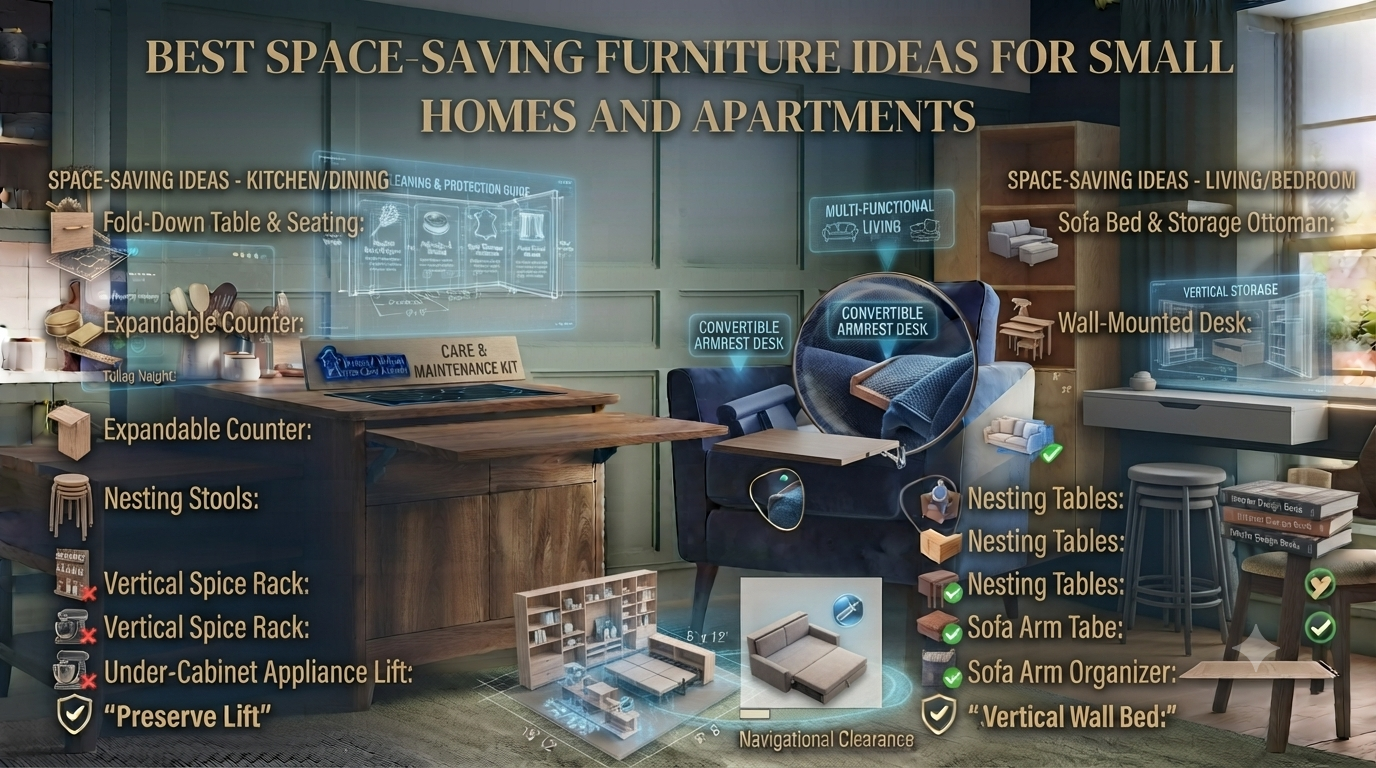
Living in a compact home, studio apartment, or cozy urban footprint often feels like a daily game of spatial Tetris. Every square foot carries high value, and choosing the wrong couch, dining table, or bed can instantly transform an open layout into a cramped obstacle course.
At Homes & Kitchens, our philosophy is built on Knowledge Before Products, Trust Before Commission, and Research Before Opinion. We believe that small-space living is not about compromising your lifestyle or comfort; it is about choosing smarter, multi-functional pieces that work harder for your daily routine.
Whether you are furnishing a first apartment, setting up a compact home office, or optimizing a multi-purpose guest bedroom, this comprehensive guide explores the best space-saving furniture ideas, engineering mechanisms, layout strategies, and top expert recommendations.
The Core Philosophy of Small-Space Furniture Design
When floor space is scarce, standard single-purpose furniture creates dead zones—areas that consume physical room while serving only one function for a fraction of the day.
[Single-Purpose Clutter] ──> [Multi-Functional Adaptation] ──> [Vertical Cubic Optimization] ──> [Fluid Traffic Flow]
To master small-space design, you must look beyond horizontal square footage and evaluate your rooms through vertical cubic volume and multifunctional adaptability. Let’s explore the top furniture categories engineered to maximize compact homes.
1. Multi-Functional Seating and Living Room Solutions
The living room is typically the hardest working space in a compact home, functioning as a media lounge, remote workspace, and occasional guest room.
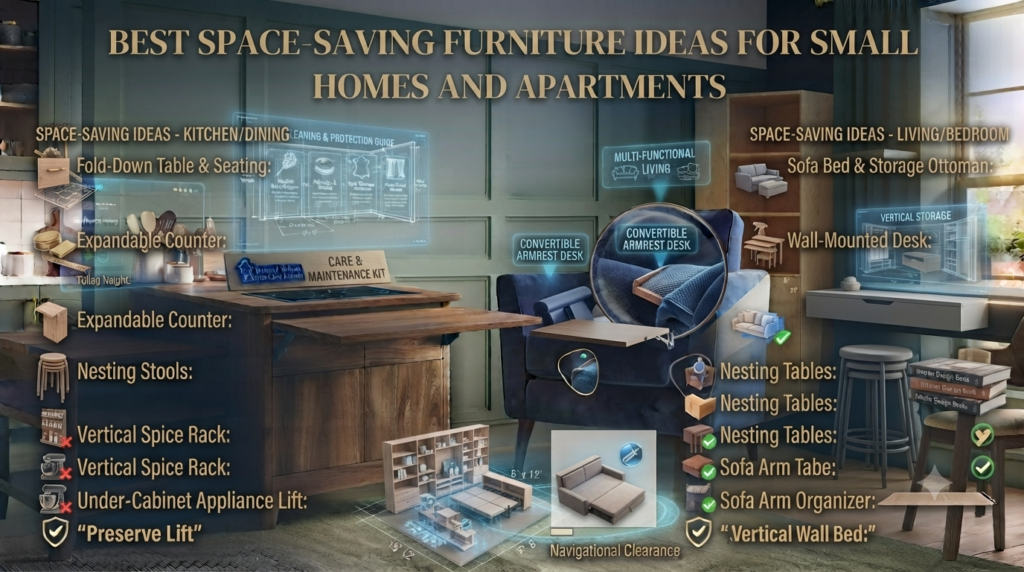
- Storage Ottomans and Benches: An upholstered storage ottoman serves as a footrest, extra seating for guests, a coffee table when topped with a wooden tray, and a hidden compartment for storing bulky winter blankets.
- Modular Sectionals with Hidden Chaises: Look for modular sofas where the chaise lounge can be reconfigured to either side, allowing the piece to adapt if you move or rearrange your layout. For foundational sizing and clearance rules, review our guide on How to Measure Your Home Before Buying Furniture.
- Nesting Coffee Tables: Instead of a massive, fixed center table, nesting tables provide tiered surfaces that pull out when you need extra tabletop space for entertaining and slide neatly underneath each other when floor space is required.
2. Transforming Dining and Workspace Solutions
Dining tables and home desks consume massive footprints if they remain fully expanded 24 hours a day.
- Drop-Leaf and Gateleg Tables: Drop-leaf tables feature hinged side panels that fold downward against a narrow center console when not in use. A table that seats six during weekend dinner parties can collapse into a slim console desk during the workweek.
- Wall-Mounted Folding Desks: For remote workers in small apartments, wall-mounted fold-down desks provide a sturdy work surface during business hours and fold flat against the wall when closed, eliminating chair obstruction.
- Extendable Console-to-Dining Tables: Modern engineering allows sleek console tables to pull apart accordion-style, inserting up to five hidden leaves to seat ten people comfortably. For complementary spatial ideas, see our Furniture Arrangement Ideas.
3. Bedroom and Sleeping Solutions for Compact Footprints
The bed is traditionally the largest furniture item in any home, often dominating an entire bedroom and rendering the space unusable during daylight hours.
- Hydraulic Lift-Up Storage Beds (Platform Beds): Instead of low-profile frames that waste under-bed clearance, hydraulic piston beds allow you to lift the entire mattress platform effortlessly. The cavernous interior compartment acts as a second closet for off-season wardrobes and luggage.
- Wall Beds (Murphy Beds): Modern Murphy beds integrate seamlessly into custom shelving cabinetry. When folded up, the unit resembles a stylish bookcase or media center; when pulled down, it offers a full-size or queen mattress with standard support slats.
- Daybeds with Trundles: Ideal for dual-purpose guest rooms and home offices, daybeds function as a cozy sofa by day and slide out into a twin bed or elevate to king size by night.
Expert Product Recommendations for Small Spaces
To help you navigate the vast market of compact furniture, we have evaluated top-performing categories based on engineering quality, material durability, and real-world functionality.
1. Best Overall Space-Saving Solution: Hydraulic Lift Storage Platform Bed
- Why We Chose It: It converts dead under-bed clearance into accessible storage without requiring physical lifting effort, thanks to heavy-duty hydraulic gas pistons.
- Key Benefits: Eliminates the need for awkward under-bed plastic bins; provides dust-free concealed storage equal to a large dresser.
- Considerations: Requires assembly and a quality mattress that matches the frame weight specifications.
2. Best Budget Space-Saving Solution: Nesting Coffee Table Set
- Why We Chose It: Offers flexible surface space and can be tucked away instantly to clear floor space for exercise or play areas.
- Key Benefits: Lightweight, highly affordable, and fits diverse interior design styles from industrial to mid-century modern.
- Considerations: Smaller auxiliary tables have lower weight capacities; avoid sitting on nested side tables.
3. Best Premium Space-Saving Solution: Extendable Wall-Bed Cabinet Unit
- Why We Chose It: Transforms a dedicated guest bedroom into an open home office or fitness studio without sacrificing sleeping comfort.
- Key Benefits: Professional-grade piston mechanisms, premium hardwood cabinetry finishes, and built-in LED reading lights.
- Considerations: High initial investment and professional wall-anchoring installation required.
4. Best for Apartments: Drop-Leaf Dining Table
- Why We Chose It: Solves the dilemma of hosting dinner guests in a studio apartment without permanently crowding the kitchen or living room.
- Key Benefits: Highly adaptable footprint; doubles as a writing desk or buffet server when collapsed.
- Considerations: Hinged drop-leaves have weight limits near the outer edges.
5. Best for Small Kitchens / Dining Nooks: Storage Banquette Seating
- Why We Chose It: Replaces bulky dining chairs with corner bench seating that features deep lift-up storage compartments beneath the cushions.
- Key Benefits: Maximizes corner dead zones and accommodates more diners around a compact table.
- Considerations: Fixed L-shape layout restricts future room reconfigurations.
Comprehensive Space-Saving Furniture Comparison Matrix
| Furniture Category | Primary Function | Space-Saving Mechanism | Weight Capacity | Best Room Application | Maintenance Needs |
| Hydraulic Storage Bed | Sleeping & Storage | Gas-piston mattress lift | 500–800 lbs | Master or Guest Bedroom | Periodic hinge bolt tightening |
| Drop-Leaf Table | Dining & Working | Hinged folding leaves | 150–300 lbs | Kitchen / Dining Nook | Check hinge stability annually |
| Nesting Coffee Tables | Surface & Accent | Under-table sliding tier | 50–100 lbs (per table) | Living Room | Wipe clean with microfiber cloth |
| Storage Ottoman | Seating & Hidden Storage | Removable or hinged lid | 250–350 lbs | Living Room / Entryway | Vacuum fabric and condition leather |
| Wall-Mounted Desk | Remote Work | Fold-down vertical hinge | 50–75 lbs | Home Office / Bedroom | Ensure secure wall-stud anchoring |
Step-by-Step Small-Space Layout Strategy
Choosing the right furniture is only half the battle; how you arrange it dictates the psychological spaciousness of your home.
- Embrace Visual Lightness: Choose furniture with exposed legs (sofa legs, table legs) rather than heavy block bases that sit directly on the floor. Allowing light to pass underneath furniture makes the floor area appear larger.
- Utilize Vertical Wall Space: When floor space is exhausted, move upward. Install floating bookshelves, wall-mounted lighting, and tall vertical mirrors to draw the eye upward and enhance cubic volume.
- Maintain Clear Traffic Lanes: Ensure you maintain at least 30 to 36 inches of clear walking clearance between major furniture groupings to prevent rooms from feeling cluttered and claustrophobic. For long-term care instructions on your furnishings, explore our How to Care for and Maintain Your Furniture to Make It Last Longer guide.
Common Mistakes to Avoid in Small Homes
When decorating compact apartments, homeowners frequently make recurring spatial errors:
- Mistake 1: Filling a small room with tiny, undersized furniture.
- Correction: Using many tiny items actually makes a room look cluttered and chaotic. Instead, choose a few well-scaled, multi-functional pieces that anchor the space cleanly.
- Mistake 2: Blocking natural light sources with tall cabinetry.
- Correction: Keep low-profile furniture near windows and place tall shelving units against interior partition walls to maximize natural sunlight flow.
- Mistake 3: Forgetting to measure doorways and stairwells before ordering.
- Correction: Multi-functional folding and storage furniture often arrives in heavy, bulky pre-assembled boxes. Always measure entry pathways and turning radiuses beforehand.
Frequently Asked Questions
What furniture is best for a small apartment?
Multi-functional and modular pieces—such as hydraulic storage beds, drop-leaf tables, nesting coffee tables, and storage ottomans—are ideal for small apartments.
How do you maximize space with multi-functional furniture?
Multi-functional furniture eliminates the need for single-purpose items by combining roles, such as a sofa that converts into a guest bed or a coffee table with hidden storage.
What are the best space-saving dining table options?
Drop-leaf tables, gateleg tables, and extendable console tables are the most effective dining solutions for compact spaces.
How do Murphy beds work in compact rooms?
Murphy beds use spring or piston counter-balance mechanisms that allow a full-sized mattress to fold vertically up against a wall cabinet when not in use.
Are hydraulic storage beds safe to use?
Yes. Modern hydraulic storage beds feature locking gas pistons that hold the mattress securely in place while you access the under-bed storage compartment.
How much clearance do I need around a drop-leaf table?
Leave at least 30 to 36 inches of clearance around the table edges when fully extended to ensure comfortable chair pull-out space.
Can nesting tables support heavy items like laptops?
Most sturdy wooden or metal nesting tables support 50 to 100 pounds, making them ideal for laptops, coffee mugs, and books.
How do I prevent small furniture from making a room look cluttered?
Choose furniture with exposed legs, light neutral color palettes, and transparent glass or acrylic materials to maintain visual openness.
What is the difference between a gateleg table and a drop-leaf table?
A drop-leaf table typically features hinged side flaps supported by swing-out legs or brackets, whereas a gateleg table uses a pivoting wooden leg gate to support the leaf.
How do I anchor heavy wall-mounted desks safely?
Always screw wall-mounted desks directly into wooden wall studs or use heavy-duty toggle bolts designed for drywall and masonry anchor security.
Are storage ottomans durable enough for daily seating?
High-quality storage ottomans feature solid wood frames and high-density foam padding, making them fully durable for daily footrests and extra guest seating.
Do Murphy beds require professional installation?
Many Murphy beds require wall-anchoring to prevent tipping hazards, so professional installation or careful adherence to manufacturer instructions is strongly recommended.
How do I choose the right sofa size for a small living room?
Measure your room dimensions, subtract required walking corridors, and choose a streamlined loveseat or apartment-sized sofa with slim armrests.
Can I use space-saving furniture in rental apartments?
Yes, but prioritize freestanding multi-functional furniture (like nesting tables and storage beds) rather than permanent wall-mounted installations to protect your security deposit.
How often should I inspect moving furniture mechanisms?
Inspect hinges, pistons, and folding brackets on drop-leaf tables and storage beds annually, tightening loose screws to ensure smooth operation.
Conclusion and Final Verdict
Optimizing a small home or apartment does not require sacrificing your personal style or everyday comfort. By investing in smart, multi-functional furniture, embracing vertical storage solutions, and maintaining clean traffic corridors, you can transform even the most compact studio into an organized, highly functional sanctuary. Knowledge of your space and deliberate furniture selection are the ultimate keys to successful small-space living.
Key Takeaways
- Prioritize dual-purpose items: Choose furniture that serves two or more roles, such as storage beds, drop-leaf tables, and storage ottomans.
- Look upward: Utilize vertical cubic volume with wall-mounted desks, floating shelves, and tall cabinetry.
- Maintain visual openness: Select furniture with exposed legs and light finishes to keep rooms feeling spacious and airy.
- Measure carefully: Always verify room layouts and doorway clearances before purchasing large multi-functional units.
Ready to transform your compact living space? Evaluate your room layouts today, explore our recommended multi-functional solutions, and start creating a home that is both beautiful and