
Introduction
Major household appliances represent a significant financial commitment. When you invest in a refrigerator, a laundry suite, or a dishwasher, you expect years of uninterrupted daily service. Yet, unlike past decades when washing machines and ranges routinely ran for 30 years with minimal fuss, modern appliances feature complex computer boards, multi-zone sensors, and energy-efficient digital motors that alter their durability profiles.
Understanding how long your appliances are designed to last helps you budget for future replacements, troubleshoot sudden breakdowns, and determine whether a costly technician visit is genuinely worth your money or throwing good cash after bad.
This guide provides definitive lifespan benchmarks for every major home appliance category, analyzes the root causes of premature failure, and outlines a practical framework for deciding whether to repair or replace your aging equipment.
The Master Appliance Lifespan Chart
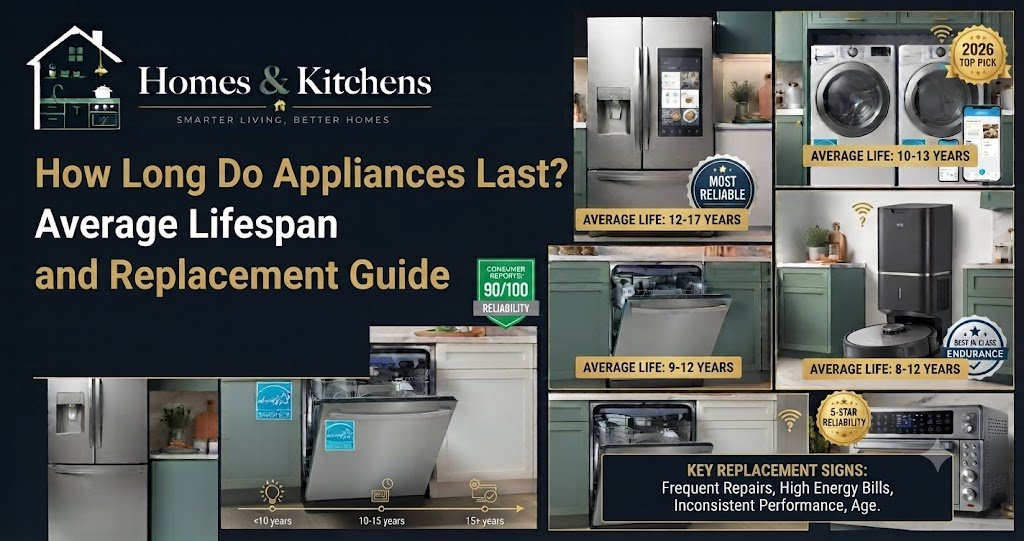
To give you an immediate reference point, the following chart aggregates data from the National Association of Home Builders (NAHB), independent trade organizations, and field service networks.
| Appliance Category | Average Lifespan Range | Primary End-of-Life Failure Point |
| Refrigerator (Freestanding) | 10 to 15 Years | Compressor burnout, sealed system refrigerant leak |
| Refrigerator (Built-In Luxury) | 18 to 25 Years | Control board failure, aging evaporator fans |
| Washing Machine (Front-Load) | 10 to 13 Years | Outer tub bearing wear, door boot mold/gasket fatigue |
| Washing Machine (Top-Load) | 11 to 14 Years | Transmission failure, drive belt snap, agitator wear |
| Clothes Dryer (Gas & Electric) | 10 to 13 Years | Heating element burnout, thermal fuse trip, drum rollers |
| Dishwasher | 9 to 12 Years | Circulation pump motor seizure, control board failure |
| Gas Range / Cooktop | 13 to 17 Years | Igniter failure, gas valve wear, thermostat drift |
| Electric Range / Cooktop | 12 to 15 Years | Surface element burnout, internal wiring short |
| Microwave (Over-the-Range) | 7 to 10 Years | Magnetron tube burnout, door safety switch failure |
Deep Dive: Lifespan Breakdown by Appliance Type
1. Refrigerators (10 to 15+ Years)
Refrigerators are the hardest-working appliances in your home, running 24 hours a day, 365 days a year.
- The Variance: Standard freestanding top-freezer models typically outlast complex French-door or side-by-side units. Why? Simpler mechanical layouts, fewer electronic dampers, and the absence of through-the-door ice and water dispensers—which are notorious failure points.
- Luxury Exception: High-end built-in brands (such as Sub-Zero) feature commercial-grade compressors and dual-refrigeration systems designed to be completely rebuildable, frequently lasting 20 years or more.
2. Washing Machines (10 to 14 Years)
Washers manage heavy loads, high centrifugal spin speeds, and constant moisture exposure.
- Front-Loaders vs. Top-Loaders: Front-load washers spin at much higher RPMs to extract water, which cuts down dryer times. However, this high-speed spin places intense stress on drum bearings and outer tub seals. If bearings fail, the repair cost often rivals a new machine. Traditional top-loaders lack complex door boots and high-speed tub seals, making their mechanical transmissions easier to service.
3. Clothes Dryers (10 to 13 Years)
Dryers boast a relatively simple mechanical architecture: a motor, a blower wheel, a belt, and a heat source.
- Gas vs. Electric: Gas dryers and electric dryers have similar lifespans, though gas models rely on igniters and gas valves, while electric models rely on heavy-duty resistance heating coils. The single greatest lifespan killer for any dryer is a clogged, lint-choked exhaust duct, which forces the blower motor and thermal fuse to overheat continuously.
4. Dishwashers (9 to 12 Years)
Dishwashers have the shortest average lifespan of any major kitchen appliance.
- The Culprit: They combine hot water, harsh detergent chemistry, hard mineral deposits (calcium/lime), and high-cycle pump motors in a compact enclosure. Homes with hard water frequently experience circulation pump or drain valve failures by year 7 if filters are neglected. Premium brands featuring stainless steel filtration systems and integrated water softeners routinely push past the 12-year mark.
Why Don’t Modern Appliances Last As Long As They Used To?
Many homeowners harbor a lingering suspicion that modern appliances are engineered to fail prematurely. Data from trade groups like the Association of Home Appliance Manufacturers (AHAM) confirms that average lifespans have drifted downward compared to robust, all-mechanical units built in the 1970s and 1980s.
- Complex Microelectronics: Older machines relied on mechanical rotary timers. Modern units rely on integrated circuit boards that are sensitive to electrical surges, humidity, and kitchen heat.
- Lightweight Materials: To reduce shipping weights and manufacturing costs, internal chassis components now frequently incorporate high-impact plastics where cast iron or heavy steel once stood.
- Energy Regulations: Federal mandates for water and energy conservation mean dishwashers and washing machines use less water per cycle, requiring longer run times and more intensive pump cycles to achieve the same cleaning results.
For broader design and layout context during a kitchen update, reference our comprehensive Kitchen Appliances Buying Guide.
The “Repair vs. Replace” Rule: The 50% Formula
When an appliance breaks down outside of its 1-year manufacturer warranty, you face a critical decision. Blindly calling a technician for every minor issue can waste money, but replacing a machine prematurely is equally wasteful.
Apply the 50% Rule combined with appliance age to make your decision:
- Example A: Your 3-year-old dishwasher requires a $200 circulation pump repair, and a comparable new model costs $800. Repair it.
- Example B: Your 11-year-old refrigerator requires a $600 sealed-system evaporator replacement. Because the unit is past its prime lifespan window, spending 60% of the cost of a new refrigerator on an aging chassis is financially unsound. Replace it.
How to Dramatically Extend Your Appliance Lifespan
You cannot control factory manufacturing quality, but you can control home maintenance. Adopting these simple habits adds years to your equipment:
- Clean Refrigerator Coils: Vacuum pet hair and dust from the condenser coils underneath or behind your refrigerator every 6 to 12 months. A dust-blanketed coil forces the compressor to overheat and burn out early.
- Scrub Dishwasher Filters: Manually remove and wash your dishwasher’s cylindrical filter monthly. Preventing food debris from clogging the wash arms protects the pump motor.
- Inspect Dryer Vent Ducts: Clean your exterior dryer exhaust vent annually. Restrictive airflow increases drying times and strains the motor.
- Leave Washer Doors Ajar: After your final load of laundry on a front-load washer, leave the door slightly ajar to let the rubber door seal dry out, preventing musty mildew and gasket degradation.
- Protect With Surge Protectors: Plug electronic-heavy ranges, refrigerators, and smart laundry units into dedicated surge protectors rather than bare wall outlets to shield delicate microprocessors from grid voltage spikes.
Frequently Asked Questions
1. Are extended warranties worth buying to protect against early failure?
Generally, no. Retailers push extended warranties because they carry massive profit margins. Most major appliance components are covered during the first year by the manufacturer, and many major credit cards automatically extend that warranty by an additional year. Setting aside your warranty budget in a personal repair fund is usually more economical.
2. Can I perform appliance repairs myself, or do I need a professional?
Simple mechanical fixes—such as replacing a dryer belt, swapping a burnt-out oven igniter, changing a water inlet valve, or cleaning a dishwasher drain pump—are well within the capabilities of a handy DIYer. However, any repair involving sealed refrigerant lines (refrigerators) or high-voltage 240V wiring should always be left to certified professionals.
3. Do premium luxury brands last significantly longer?
Yes. High-end brands like Miele, Bosch (800 series), Sub-Zero, and Wolf utilize commercial-grade stainless steel assemblies, heavy-duty induction motors, and accessible internal parts designed for easy servicing, often doubling the operational lifespan of budget retail alternatives.
4. When should I replace an appliance even if it still works?
Energy consumption is a major factor. If you own a refrigerator built in the late 1990s or early 2000s, replacing it with a modern ENERGY STAR certified unit can lower your annual electricity bill enough to pay for a substantial portion of the new machine over a few years.
Final Verdict
Appliances are investments in domestic efficiency. While modern units may not run for three decades like vintage models, paying attention to baseline durability, matching brand selections to proven categories, and committing to routine maintenance safeguards your household workflow and budget.
Conclusion
Knowing how long your home appliances are expected to last prevents surprise household disruptions. By monitoring wear milestones, applying the 50% repair rule, and performing seasonal upkeep, you maximize your investment and ensure your home infrastructure runs smoothly.
For further insights on managing your home systems, explore our related guides on The Most Reliable Home Appliance Brands in 2026, Kitchen Appliances vs. Smart Appliances, and Kitchen Remodel Cost Guide.